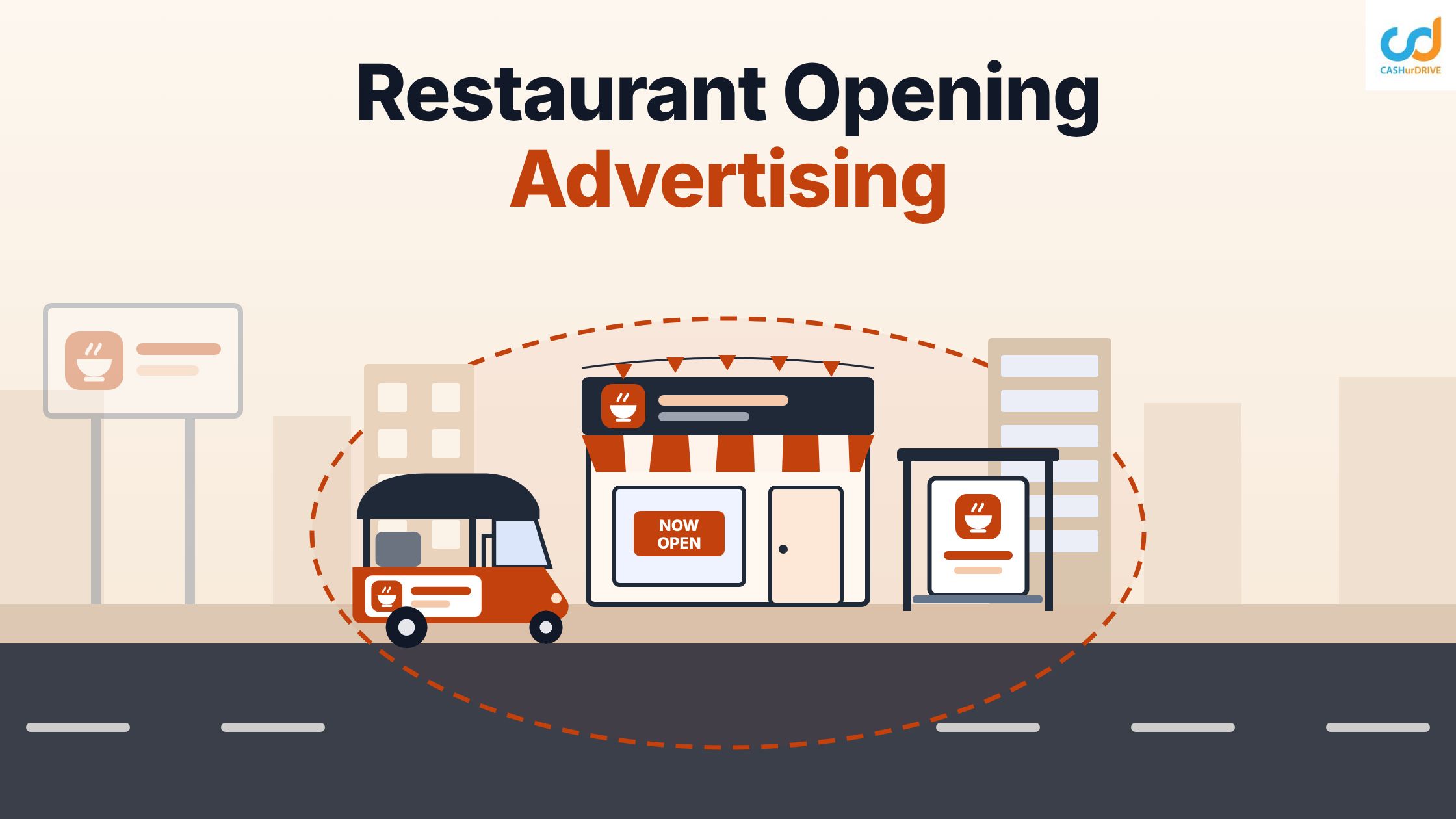
Opening a New Restaurant? How to Plan Outdoor Advertising That Reaches Local Customers
 By Annu
The fit-out is almost done. The menu is final, the staff are trained, and the opening date is on the calendar. Now one question remains: will anyone nearby notice? That is the job of restaurant opening advertising. Yet the most common waste in restaurant launch advertising is visibility in places your customers will never travel from. This guide shows how to plan outdoor advertising for restaurants around the people who can actually reach you.
Competition starts on your own street. Delhi alone has 1,20,419 restaurants, according to NRAI’s 2024 report (Millennium Post). Nationally, the sector was worth ₹5.69 lakh crore in FY24.
Why restaurant opening advertising starts with a map, not a hoarding
Dine-in and delivery catchments are not the same area
Your catchment is the area your likely customers live, work and travel through. For a restaurant, there are usually two. The dine-in catchment is shaped by roads, traffic and how far people will travel for a meal. The delivery area, on the other hand, is set by your delivery partners and kitchen capacity. These two areas often overlap, but they are rarely the same shape. As a result, restaurant opening advertising aimed at delivery customers may sit in the wrong place for dine-in guests.
However, there is no universal radius. Catchment size depends on the city, traffic, price point and format. A destination restaurant may draw diners from across the city. A neighbourhood café, by contrast, depends on the streets around it. High-street and mall outlets also get walk-ins who decide on the spot. For them, visibility where they pass, such as the approach road or mall entrance, often matters most.
Where most launch budgets leak
Many owners start their restaurant opening advertising with a single large hoarding in a prominent spot. It looks impressive, but much of its audience may live too far away to visit. Meanwhile, the streets right around the outlet get no attention at all. Of course, citywide reach can make sense for a chain. For example, Nom Nom Express wrapped local trains and branded buses across Mumbai. It also wrapped about 1,500 taxis and autos while growing a network of about 45 outlets (Restaurant India). A single new outlet, however, usually needs depth in a small area instead. In practice, that means several smaller placements inside the catchment, not one large site.
Building your catchment map in four steps
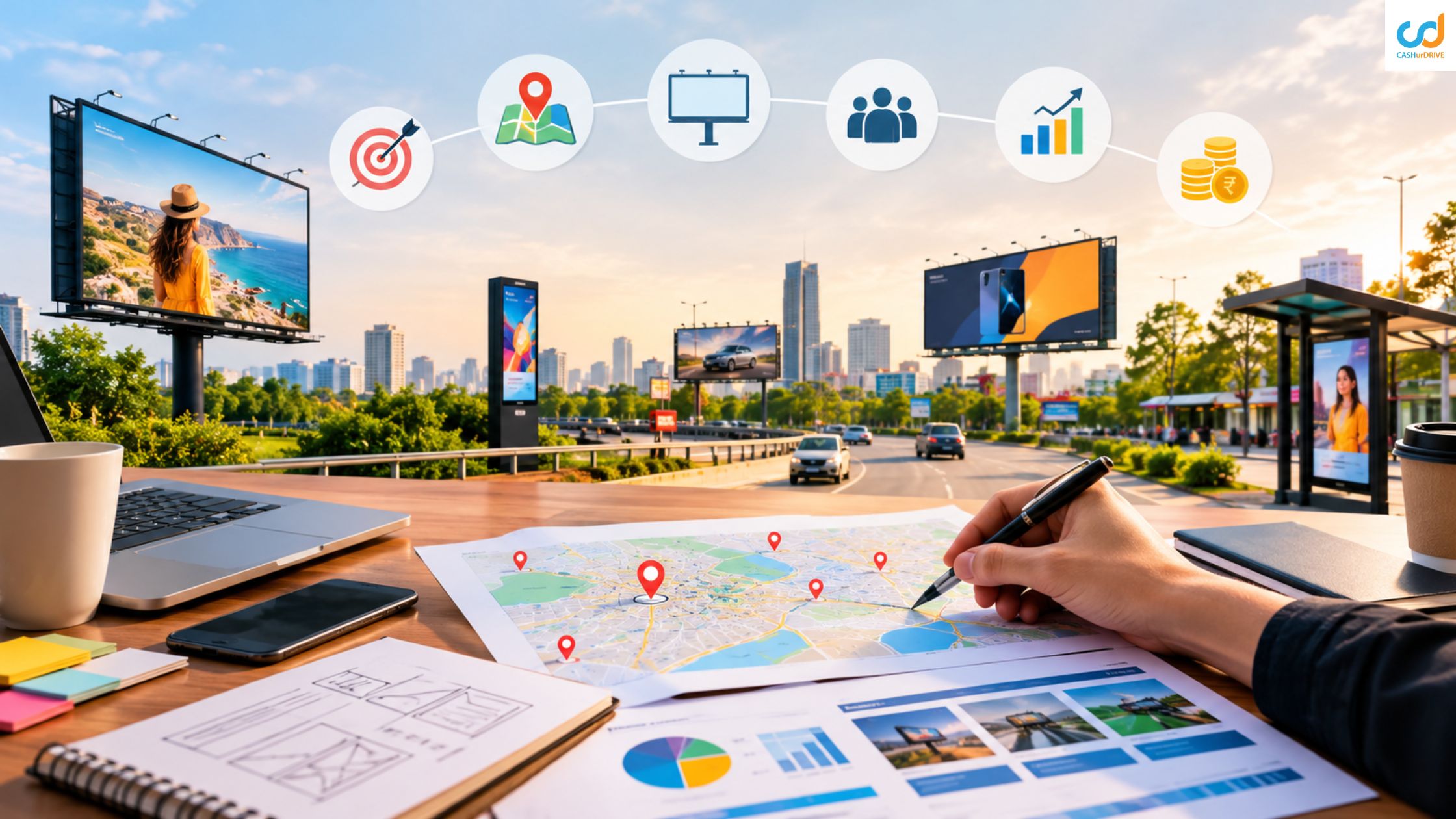
Before choosing any format for your restaurant opening advertising, map where customers are likely to come from.
- Mark the outlet and its approach routes. Note the main roads, metro stops and bus stops people use to reach you.
- Draw the dine-in catchment. Think about where likely guests live, work or study. Then check travel times on a map app during your lunch and dinner hours. Note where the trip starts to feel inconvenient, and draw your boundary there.
- Draw the delivery area separately. Check what your delivery partners cover, and how far your kitchen can serve while food stays good.
- List the points people pass every day. Junctions, bus shelters, housing society gates, office clusters and malls all become candidate sites. Visit and photograph the shortlisted ones, and verify each site before booking.
Also check local permissions before placing banners or hoardings near the outlet. Rules differ by city and municipality, so ask your local municipal body or media partner first.
Matching outdoor formats to each job in the launch
Each outdoor format does a different job, so treat this table as starting points. The right choice still depends on the city, the site or route, free inventory for your dates, and your audience.
| Launch job | Formats often considered | Why they can fit | Check before booking |
| Signal the location on the approach road | Hoarding or unipole near the outlet | Large and fixed; tells people where you are | Visibility, angle and obstructions |
| Reach residents and office-goers nearby | Bus shelters, auto-rickshaw branding | Repeated exposure on daily routes | Route coverage and proof of display |
| Reach mall visitors (for a mall outlet) | Mall media near entrances and food courts | Catches people already close by | Mall rules and placement |
| Change messages across the launch | DOOH, where available | Teaser first, then “now open” | Screen location and slot share |
| Build presence on a street over time | Wall painting, where permitted | Long-lasting local visibility | Permissions and wall condition |
If the budget is limited, secure the approach-road signal first. Then add frequency inside the catchment with the stops and routes your neighbours use. For more on transit formats, see how transit media supports new store openings.
Sequencing restaurant opening advertising: before, during and after
Once the sites are chosen, the order in which you use them matters just as much. To set your start date, work backwards from the opening date. Allow time for booking sites, printing creative, installation and any permissions. Your media partner can confirm the timings. The phases below are illustrative, so adjust them to your plan.
Before opening: let the neighbourhood know you’re coming
Start with a simple “opening soon” message. Place it on the approach road and near homes and offices. A teaser can also build curiosity. For instance, Haldiram’s ran billboards carrying only the line “Acche Din Aane Wale Hai!” It then announced its expansion into Lucknow and Gorakhpur. No results were reported, but the sequence is a useful model.
Opening week: be impossible to miss nearby
If you hold a soft launch first, keep advertising light during it. Start peak advertising only when the kitchen and service are ready. Otherwise, a crowded week with slow service can bring poor early reviews. Then concentrate your restaurant opening advertising in the tightest area around the outlet. Switch the message to “now open”, and add one clear reason to visit. In addition, include an opening offer with a code printed only on your outdoor ads. That code also becomes a tracking signal. Meanwhile, moving transit formats such as autos repeat the message across nearby streets.
After opening: stay visible while habits form
Finally, keep a lighter presence in your core catchment. First visits matter, but repeat visits build a restaurant. Accordingly, shift the message to a signature dish or a reason to come back. Keep going while your tracked signals hold up, then scale down.
A hypothetical example: a café opening in Pune
HYPOTHETICAL. A café opens on a busy Pune street near offices and housing societies. It places a unipole on the main approach road, because most guests will arrive along it. Next, it books ads at two bus shelters used by nearby office workers, its likely lunch crowd. Autos then carry its branding through the residential lanes where evening and weekend guests live. To track responses, staff ask “How did you hear about us?” at billing. The outdoor ads also carry an offer code. This example shows the method only; it does not describe real results.
Creative that works on the street
On the street, restaurant OOH advertising has a few seconds to work, often while people are moving. As a result, keep the message simple: your name, what you serve, where you are, and one reason to visit. As a practical guideline (not a rule), aim for around seven words of main copy. In addition, show your food clearly and keep the background uncluttered. A direction cue, for example “200 m ahead” or a landmark, can help on approaching roads. Also, in many Indian cities, local-language or bilingual copy may read faster for nearby residents.
How to tell whether the launch is working
A new outlet has no sales history to compare against. Therefore, a simple before-and-after comparison is not possible. Instead, set simple targets from your opening plan before launch. Then track signals from week one and read them carefully.
Signals you can track from week one
|
Signal |
What it can suggest |
Its limitation |
|
“How did you hear about us?” at billing |
Which channels guests remember | Memory is imperfect; many won’t answer |
|
An offer code shown only on outdoor ads |
A trackable response to the outdoor creative | Codes get shared; many viewers won’t use one |
| Calls and direction requests on your Google Business Profile | Local interest in the outlet |
Also driven by listings, reviews and word of mouth |
| Delivery orders by area, if your partner dashboard provides it | Where demand is coming from |
Affected by offers, ratings and delivery coverage |
Why early numbers need careful reading
Opening weeks are noisy. For example, curiosity, friends and family, launch offers and reviews all move the same numbers. Therefore, treat any link between restaurant opening advertising and early sales as a correlation, not proof. Where possible, also compare with similar outlets you already run.
Plan your opening around your catchment
The best time to approach a media partner is once your site and opening window are confirmed. That leaves room for site checks, permissions and production. Bring your catchment map, opening date, approximate budget, menu or opening offer, and delivery-area details.
Good local restaurant launch marketing starts with that map of where guests live, pass and can be served. Then fill those spaces with the right formats, in the right order. That is how restaurant opening advertising can turn local visibility into first visits. To get started, request an indicative media plan from CashUrDrive, with location and format recommendations for your outlet’s catchment.
Frequently asked questions
Q1: How early should restaurant opening advertising start?
There is no fixed rule. Work backwards from your opening date. Lead times vary by format and city, so confirm them early with your media partner.
Q2: Does outdoor advertising suit a cloud kitchen?
It can, if the ads run within your delivery area and point people to where they can order.
Q3: Do I need permission for banners outside my restaurant?
Often, yes. Rules differ by city and municipality, so check with your local municipal body before putting up banners or hoardings.
Q4: How much does restaurant opening advertising cost?
It depends on the formats, sites, city, duration and production. For that reason, ask for an itemised quote and compare quotes line by line.