Mall Advertising Agencies in India: What to Evaluate Before Choosing a Media Partner
 By Annu
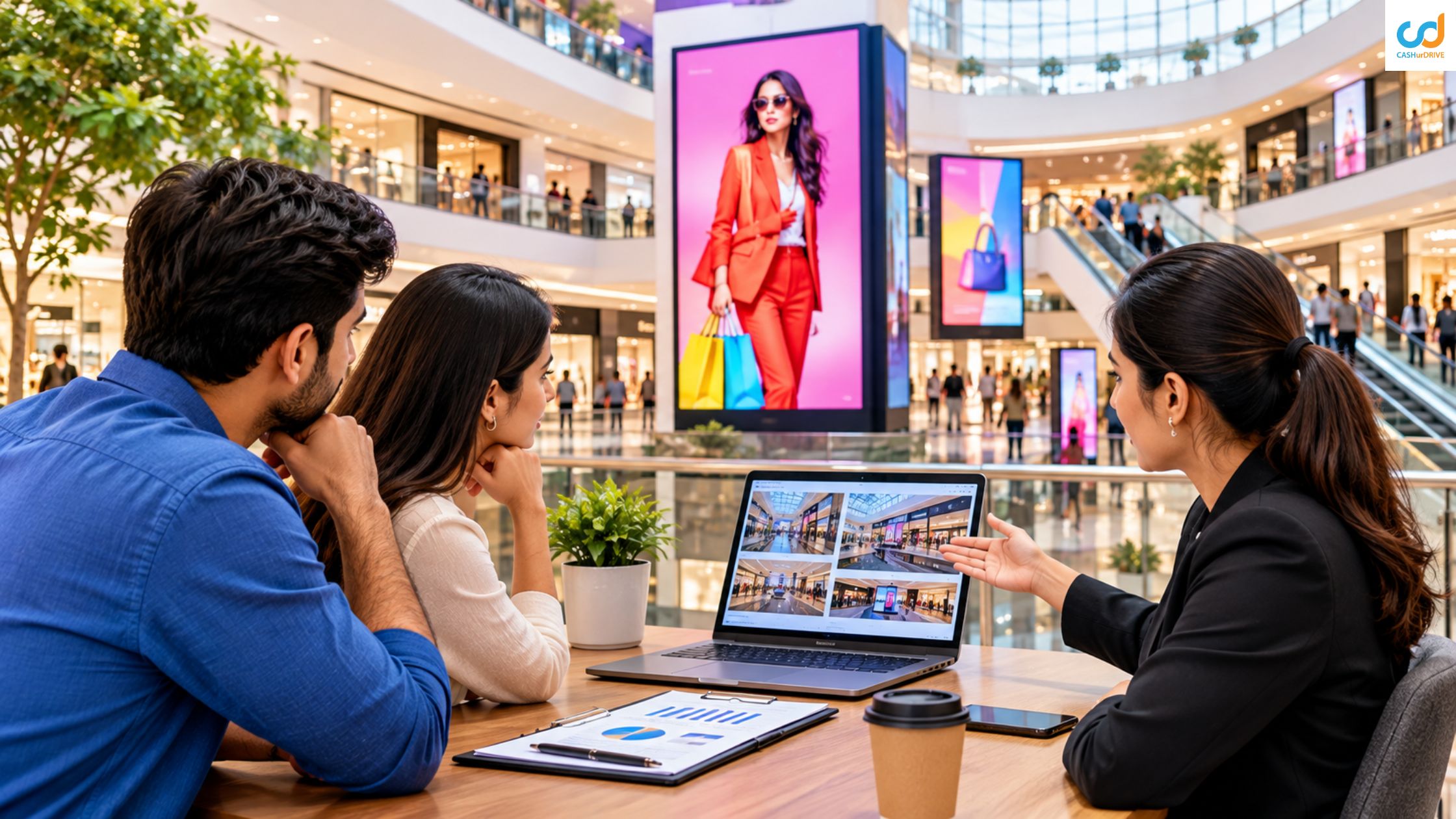
A mall advertising agency in India is a media planning and execution partner. It secures advertising placements inside shopping malls. It also manages format access, permissions, creative specifications, and campaign reporting. The agency you choose determines more than the price you pay. It determines which malls you can book, which formats are available, and whether your post-campaign report is useful.
What this guide covers: Choosing the right mall advertising agency in India comes down to five checks. First, confirm the agency has direct relationships with mall management – not reseller access. Second, verify which formats and properties it can place. Third, ask what audience data it uses. Fourth, assess its execution capability. Fifth, review its post-campaign reporting quality. An agency that passes all five checks reduces wasted spend.
|
Evaluation Criteria |
Why It Matters |
|
Direct mall access |
Resellers can’t confirm real-time availability or guarantee pricing |
|
Format inventory |
A limited format set means the brief gets shaped around what’s available |
| Audience data |
Headline footfall figures don’t tell you which income segment is visiting |
| Execution capability |
Multi-city launches need coordinated installations across mall operators |
| Post-campaign reporting |
Spend estimates aren’t measurement – play logs and verified footfall data are |
What a Mall Advertising Agency in India Does
A mall advertising agency in India manages the full process of placing your brand inside a shopping mall. This includes identifying malls that match your target audience, negotiating contracts with mall management, coordinating creative production, overseeing installation, and delivering a post-campaign report.
The key distinction is between agencies that hold direct agreements with mall operators and those that work through intermediaries. India’s premium mall market is concentrated. DLF, Nexus, Phoenix, Prestige, and Inorbit together account for a large share of Grade A mall inventory across Delhi NCR, Mumbai, Bangalore, Hyderabad, and Pune. An agency with direct contracts across these operators gives you actual inventory and firm pricing. A reseller gives you a quote that may change.
For brands running activations, mall agencies also handle non-traditional placements. This includes experiential zones, pop-up installations, floor decal campaigns, and sampling activities. These require vendor relationships that go beyond media buying – into event permissions and operations.
Best for: Brands planning campaigns across multiple malls or cities, and brands that need both media and activation managed by a single partner.
Mall Advertising Formats and Partners Inside Indian Malls
Indian malls offer more placement options than most brands account for when building a brief. The format you choose affects who sees your message, how long they see it, and in what context. The partner you choose decides which of those formats you can actually book.
CashUrDrive Marketing Ltd.
Best for: Brands that want mall advertising planned around verified audience data, with media, activation and reporting handled by one partner.
CashUrDrive Marketing Ltd. was set up in July 2009 and offers end-to-end advertising solutions. It was founded by Raghu Khanna, a first-generation entrepreneur. Its registered office is in Sector 17C, Chandigarh. The company is listed on NSE Emerge under the ticker CUDML.
Its services cover transit media, outdoor media, print media, and digital media. The company started with advertising on cars. It has since expanded into bus branding, billboards, outdoor campaigns, and digital marketing. It focuses on building its own media inventory rather than trading inventory owned by others.
For mall campaigns, CashUrDrive uses its Atlas platform. Atlas maps the audience at a specific mall location by NCCS segment, footfall density, and daypart patterns before the brief is written. After the campaign, Atlas tracks whether exposed audiences visited a store or engaged with the brand online. That gives performance marketers a measurable link between mall spend and results.
Atrium Banners and Hoardings
Best for: Brand awareness campaigns targeting the broadest possible in-mall audience.
Atrium banners occupy the central visual field of a multi-level mall. They’re visible from the ground floor to the top floor. They generate passive impressions across all shopper categories.
In premium Grade A malls – like Phoenix Palladium (Mumbai), Select Citywalk (Delhi), and UB City (Bangalore) – atrium placements command the highest rates. Expect ₹3,00,000 to ₹8,00,000 per month depending on size and duration.
Atrium banners require large-format artwork that reads clearly at height and distance. Ask the agency for specification sheets early if your creative team hasn’t worked with this format before.
Digital Mall Screens
Best for: Time-sensitive campaigns and brands running multiple creative variants simultaneously.
Digital out-of-home (DOOH) screens inside malls now appear at entry points, food courts, elevator lobbies, and multi-brand retail zones in most Grade A properties. Unlike static formats, DOOH lets you schedule daypart content. You can run one creative for afternoon shoppers and another for evening footfall.
This matters when you’re launching a product or running a time-bound promotion. Dynamic content also means you can update creative without paying for new print production. For FMCG brands running tactical promotions, this flexibility is often worth the premium over static placements.
Pillar Wraps and Floor-Level Branding
Best for: High-dwell-time environments where shoppers are stationary – waiting queues, food courts, cinema lobbies.
Pillar wraps turn structural columns into branded surfaces. At food courts, cinema queues, and large-format retail anchors, shoppers spend 10–25 minutes stationary. This is significantly longer than at any other OOH format. Your creative has time to communicate product detail and a clear call to action.
Floor decals are an increasingly popular tactical format, especially in consumer electronics and FMCG launches. They require mall management approval and precise installation guidelines. Agencies with direct mall relationships move this process faster.
Experiential Zones and Pop-Up Activations
Best for: Product launches, sample distribution, and brands building direct consumer interaction.
Experiential zones are branded physical spaces within the mall’s common areas. They are not traditional media placements. They require separate vendor relationships – operations, logistics, staffing – and permissions that go beyond media buying.
An agency that manages both brand visibility and the activation in one contract saves significant coordination effort. Costs vary widely: from ₹1,00,000 to ₹5,00,000+ depending on the mall, zone size, duration, and services required.
Direct Access vs Reseller Relationships: Why It Matters
When a brand books mall advertising through a reseller, the reseller checks actual availability with the original rights holder – either the mall’s media department or a master concessionaire. This adds a delay. It also introduces the risk of a gap between what you were quoted and what’s actually available.
In India’s mall advertising market, master concessionaires hold long-term exclusive rights to inventory in many properties. If your agency doesn’t have a direct agreement with one, your booking goes through an extra layer. That layer has its own margin and its own timeline.
The practical consequences are clear. You may receive a rate card that doesn’t reflect current demand. If a competitor books the same atrium banner between your quote and your contract signing, you lose the slot. An agency with direct access can confirm real-time inventory and hold placements while contracts are reviewed.
You may also receive a format downgrade. A reseller who oversells inventory may substitute your atrium banner with a pillar wrap or smaller format. Direct agencies can commit because they control the inventory.
For multi-city campaigns, this matters even more. If you’re running a simultaneous launch in Delhi, Mumbai, Bangalore, and Pune, you need one agency with direct relationships in all four markets. Managing four separate resellers is a coordination risk.
Ask your agency to confirm in writing whether their access is direct or through an intermediary. Ask for the specific mall operator contact they work with. A credible agency won’t hesitate to answer.
How to Evaluate Audience Fit for a Mall Campaign
Footfall figures are the most commonly cited metric in mall advertising proposals. A Grade A mall in Delhi NCR might quote 1,00,000 weekly visitors. But that number tells you very little about whether your target audience is part of it.
What you actually need to know:
The NCCS profile of the mall’s footfall: NCCS A1 and A2 households behave very differently from NCCS B or C households. A mall in South Delhi attracts a different income segment than a mall in Gurgaon’s Sector 83 – even with similar footfall numbers. If your brand targets premium consumers, audience quality matters more than volume.
The category mix of anchor stores: A mall anchored by Zara, Apple, and premium F&B brands signals a different shopper profile than one anchored by value fashion and budget electronics. The anchor mix is your fastest proxy for audience quality when you don’t have audience data from the agency.
Daypart traffic patterns: A food court digital screen at 1:00 PM reaches a different audience than the same screen at 6:00 PM. An agency with daypart footfall data can align your placement timing to when your target audience is most active.
CashUrDrive’s Atlas platform uses device-level geofencing and NCCS audience profiling to map the actual audience present at specific mall locations. Atlas tells you not just how many people are there – but which income segments, age brackets, and behaviour profiles are moving through. That shifts the conversation from reach volume to audience quality.
Measurement and Reporting: What a Serious Agency Provides
Post-campaign reporting in mall advertising ranges from a one-page summary to structured measurement output you can act on. The difference matters when you’re presenting results to a marketing director or CMO. A page of photographs and a footfall estimate won’t pass the bar.
DOOH Play Logs
For digital mall screen placements, a reputable agency provides verified play logs. These are timestamped records of every instance your creative was displayed. This isn’t an estimate – it’s a reconciled record of actual ad delivery. If the contract said 6 plays per hour between 10 AM and 9 PM for 14 days, the play log confirms it happened.
Ask for play logs as a delivery requirement before signing the contract.
Footfall Reconciliation
Many malls provide weekly footfall data via their tenant portal. A thorough agency cross-references this data against your campaign period. The result is an evidence-based impression estimate – not a projected figure from a rate card.
Brand Lift Indicators
For premium campaigns, some agencies provide post-campaign surveys or retail footfall data from the brand’s own store locations within or near the mall. This isn’t standard from every agency. But it’s the kind of output that moves mall advertising from a brand awareness line item to a performance channel.
CashUrDrive uses Atlas post-campaign attribution to measure footfall behaviour after OOH exposure. This tracks whether audiences exposed to a campaign visited a store, browsed a product category online, or engaged with the brand’s digital touchpoints. Performance marketers need this level of reporting to include mall advertising in their attribution models.
Frequently Asked Questions
Q1: What does a mall advertising agency in India typically charge?
A mall advertising agency in India charges based on format, mall grade, city, and campaign duration. Atrium banner placements in Grade A malls range from ₹3,00,000 to ₹8,00,000 per month. Food court digital screens typically range from ₹80,000 to ₹2,50,000 per month depending on the property. Agency fees for planning, coordination, and reporting are usually 10–15% of the media spend. Multi-city campaigns generally offer volume discounts but require higher agency fees for coordination.
Q2: How long does it take to book and execute a mall advertising campaign in India?
A straightforward static format campaign in a single mall requires 3–4 weeks from confirmation to installation. Allow one week for contract and creative approval, one week for print production, and one to two weeks for installation scheduling. Experiential zones and activations need 6–8 weeks minimum. DOOH placements can move faster – creative uploads digitally, reducing lead time to 1–2 weeks once a slot is confirmed. Plan multi-city campaigns with at least a 6-week lead time.
Q3: What’s the difference between mall advertising and retail advertising in India?
Mall advertising covers placements in the mall’s common areas – atriums, corridors, food courts, and exterior hoardings. The mall’s media operator or concessionaire manages it. Retail advertising covers placements within a specific store and is managed by the brand or retailer. An outdoor media agency handles mall advertising. In-store display is typically managed by the brand’s retail or trade marketing team. The two channels work well together for product launches inside a specific retail anchor.
Q4: Which mall formats work best for FMCG and D2C brands in India?
FMCG brands benefit most from food court digital screens and atrium banners- high-dwell and high-traffic environments that allow frequent creative repetition. D2C brands building offline awareness often prioritise entry-point placements, such as mall entrance banners and parking level signage, to intercept shoppers before they commit to a category. For D2C brands running a trial drive or sampling, experiential zones near a relevant category anchor store – electronics, lifestyle, food – tend to generate the best direct engagement.
Q5: How does audience targeting work for mall advertising campaigns?
Standard mall advertising uses footfall estimates and historical traffic data to project reach. A more precise approach uses device-level geofencing data to identify which audience segments are actually present at a specific mall location – by income bracket, age profile, and category interest – before the campaign is placed. CashUrDrive’s Atlas platform matches your target NCCS segment to specific mall locations, so your brief is built on verified audience presence rather than estimated footfall volume.
Q6: Can mall advertising be integrated with a digital campaign for better attribution?
Yes. A device exposed to a mall OOH placement can be identified and retargeted with a digital ad on social or display platforms within a defined conversion window. This cross-channel approach creates a measurable path from physical exposure to digital action. CashUrDrive’s Atlas platform enables this through device-level OOH exposure tracking. Performance marketers get a data-based link between mall spend and downstream digital engagement.
Conclusion
Choosing a mall advertising agency in India comes down to one test. Does this agency give you control? Or does it leave you dependent on someone else’s availability and reporting?
Direct mall access, format-specific inventory knowledge, verified audience data, and structured post-campaign reporting are the minimum standards. An agency that can’t demonstrate all four adds uncertainty to a media spend that deserves a clearer return.
CashUrDrive’s Atlas platform maps audience presence at the location level – NCCS segment, footfall density, and daypart patterns – before you write the brief. If you’re planning a mall advertising campaign, that’s where to start.
Request an Atlas audience map for your next mall campaign at cashurdrive.com/contact