How to Compare Outdoor Advertising Agency Quotes in India: A Practical Buyer’s Checklist
 By Annu
An compare outdoor advertising agency quote is a cost proposal for OOH media. It covers billboards, transit media, or DOOH screens. Two quotes for the same brief can differ by 40%. Neither vendor is wrong. The reason: India has no standard pricing model for outdoor media. Every review must go beyond the headline cost.
This guide shows you how to compare outdoor advertising agency quotes. It covers six must-have line items. It also shows how to read reach claims. And it lists three red flags. A structured review takes under two hours. However, it can stop you from overpaying by 20-35%.
Quick Answer: To compare outdoor advertising agency quotes, check six items.
These are: format spec, exact site location, campaign length, production costs, installation charges, and post-campaign reports.
Any proposal that bundles these is incomplete. Ask each vendor to resubmit in the same format before you compare costs.
Why OOH Quotes Vary More Than You Expect
Outdoor advertising in India has no set pricing. A hoarding on NH-48 in Delhi and one on Outer Ring Road in Bangalore may look the same. However, they serve different audiences. And they do so at different rates. The quote rarely shows this gap.
Three factors drive the gap when you compare outdoor advertising agency quotes. Understanding each one stops you from choosing on price alone.
Location Detail
Some vendors quote at the route level. They may write “Outer Ring Road, Bangalore” with no site details. Others give the exact address and facing direction. A quote with no precise location cannot be checked. You are buying on faith, not data.
Impressions Method
India has no national standard for OOH impression counts. One vendor may use vehicle traffic counts. Another may use device-level location tracking. A third may use survey data. These methods can give figures that differ by three times – for the same site. Always ask which method a vendor uses before you accept any reach figure.
Production Cost Bundling
Many quotes bundle printing, installation, and removal into one cost. This makes them look cheaper at first. However, the real cost shows up on the final invoice. According to exchange4media’s OOH pricing study (2025), production and installation account for 18-24% of total spend on large formats. Ask vendors to list these costs as separate line items.
The Six Line Items Every Quote Must Include
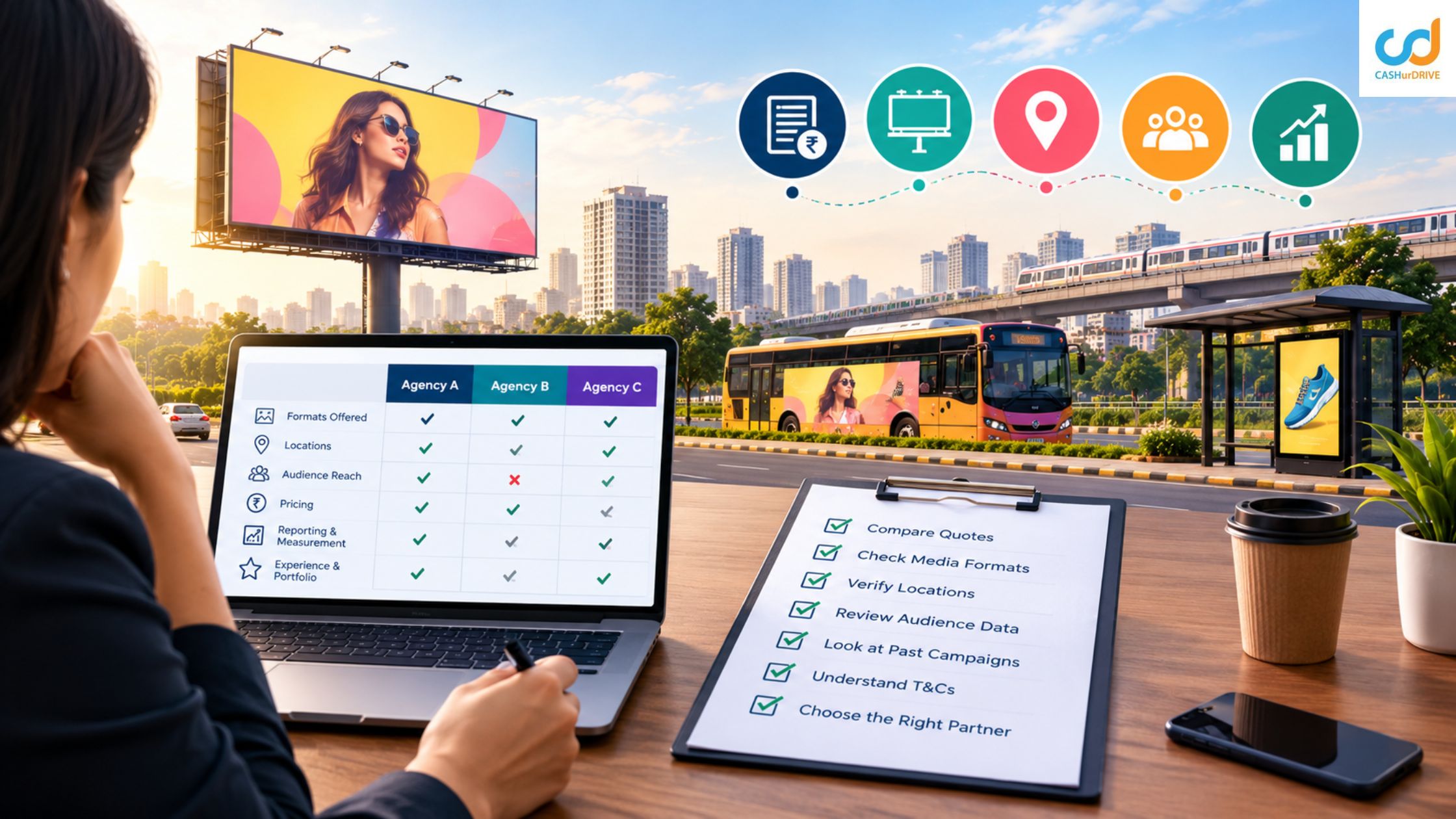
A complete outdoor advertising agency quote must list all six items below. If any is missing, return it before you compare costs.
|
S. NO. |
Required Line Item |
|
1 |
Media format – full spec (size, facing, illumination, static vs DOOH) |
|
2 |
Exact location – site address or landmark, not just a road name or zone |
|
3 |
Campaign duration – confirmed start date, end date, and total display days |
|
4 |
Production costs – printing per site, listed apart from the media rate |
| 5 |
Installation and removal – labour cost per site, as a separate line item |
| 6 |
Post-campaign reporting – stated deliverables: photos, reach data, footfall report |
Together, these six items give you one clear layout across all proposals. First, convert each proposal into this format. Then compare only at the line level. That way, a vendor who bundles production cannot look cheaper than one who lists it openly.
How to Read Audience Reach Claims
Reach claims are where proposals differ most when you compare outdoor advertising agency quotes. They also get the least scrutiny. Poor audience data leads to budget waste.
The Problem With Traffic-Count Impressions
Most Indian OOH vendors base reach figures on vehicle traffic counts. They multiply vehicles past a site by a view factor. However, this only tells you how many vehicles passed. It does not tell you who was in them.
For example, a billboard on Noida Expressway may show 120,000 daily impressions. However, for a brief targeting NCCS A1 consumers, the real reach may be 15,000 to 45,000. The quote will not show this unless you ask.
Three Questions to Ask Every Vendor
When you compare outdoor advertising agency quotes, ask each vendor three specific questions:
- What is the data source for the reach figure – vehicle count, survey, or device-level location tracking?
- Does the reach claim reflect total impressions or audience-qualified impressions for your target segment?
- Can you provide a pre-campaign audience check at the quoted site?
Vendors using device-level location tracking – such as CashUrDrive’s Atlas – can answer the third question with a verified audience map. Vendors using traffic counts alone cannot. This one question tells data-backed proposals from estimates.
Rate Cards vs. Negotiated Rates
Published rate cards in Indian OOH are a starting point. Discounts of 15-35% below card are standard. However, they are not always shown in a proposal.
To compare outdoor advertising agency quotes on rate, always ask for the rate card. That way, you can see the real discount each vendor offers.
Three Steps to Cut Through Rate Confusion
First, ask for the published rate card for every site in the proposal. Second, work out the discount per site. Third, compare all sites at the rate-card level before discounts. This stops a vendor with a high base from looking more generous than one with a lower base.
For campaigns of three months or more, negotiate a fixed monthly rate per site. According to exchange4media’s OOH market tracker (2025), FMCG and BFSI brands often secure 25-35% below card due to volume.
Three Red Flags in an OOH Agency Proposal
Most OOH proposals are clear. However, three patterns signal a weak proposal when you compare outdoor advertising agency quotes.
| ⚑ Red Flag 1: No location details
A proposal with only a road name – no site address or landmark – cannot be checked. Two vendors may be quoting different sites on the same road. Reject any proposal that lacks a precise site location. Ask for the exact address before you compare costs. |
| ⚑ Red Flag 2: Reach figures with no data source
A reach claim with no named method is an estimate. Estimates can be high without any check. Require a named source – vehicle count, survey, or device-level location tracking – before you accept any figure. No data source means no basis for comparison. |
| ⚑ Red Flag 3: No post-campaign reporting clause
A quote with no reporting clause leaves you with no proof of delivery. Reporting must be agreed in writing. Ask each vendor to state what they will provide: proof-of-display photos, reach data, and a footfall report. If this clause is missing, add it before you sign. |
Frequently Asked Questions
Q1: What do I check when I compare outdoor advertising agency quotes?
When you compare outdoor advertising agency quotes, check six line items. These are: media format with full spec, exact site location, campaign dates, production costs, installation and removal charges, and post-campaign reports. Any proposal missing one of these should be returned before you commit to a vendor. A complete quote takes under 15 minutes to review once you have the structure.
Q2: How do I compare outdoor advertising agency quotes on CPM?
First, convert all proposals to CPM using each vendor’s stated reach figure. Then ask each vendor for their data source. Device-level location tracking – used by CashUrDrive’s Atlas – is more precise than vehicle traffic counts. It also splits audience by NCCS group and commute pattern. A location-tracked CPM is more reliably delivered than one from a manual survey. Use CPM only when the data sources match.
Q3: Is it normal to negotiate OOH rates in India?
Yes. Discounts of 15-35% below rate card are standard in Indian OOH. They are most common for campaigns of three months or more. FMCG and BFSI brands often secure the strongest terms due to volume. Always ask for the rate card with the proposal. That way, you can compare the real discount across vendors – not just the final quoted cost.
Q4: What does CPM mean in outdoor advertising?
CPM stands for cost per thousand impressions. It is the standard metric for comparing OOH costs across formats, locations, and campaign lengths. For example, a hoarding giving 100,000 daily impressions at ₹2,00,000 per month has a CPM of about ₹67. By contrast, transit media at 50,000 daily impressions for ₹80,000 per month has a CPM of ₹53. CPM is the only fair tool when site counts and formats differ across proposals.
Q5: How do I verify the audience data in an OOH proposal?
Ask the vendor whether their reach figure is based on vehicle counts, survey data, or device-level location tracking. Device-level data tracks mobile device movement through a site. It can be split by NCCS group, commute pattern, and time of day. Vendors using CashUrDrive’s Atlas can provide a pre-campaign audience check. This shows your target segment is present at the site before you commit budget.
Q6: What is the best way to compare outdoor advertising agency quotes on production costs?
Ask for production costs as a separate line item in every proposal. For large-format sites, confirm the quote includes printing per site, installation labour, and removal. Together, installation and removal add about ₹15,000-₹40,000 per site in most Indian markets. For transit media, check whether vinyl wrap and removal are in the quoted rate or billed on the final invoice. A vendor who lists these clearly is easier to audit after the campaign.
Conclusion
When you compare outdoor advertising agency quotes with this framework, the review takes under two hours. However, it often shows 20-35% cost gaps between proposals that look the same at first. It also reveals gaps in audience data and reporting that would only show up after the campaign runs.
The one gap this method cannot close is whether your audience moves through those sites. Request an Atlas audience map from CashUrDrive before any booking. It shows which audience segments are present at each site – before you commit any budget.
Get an Atlas audience map before your next OOH booking.
CashUrDrive’s Atlas shows your target audience at every site – by NCCS group, commute pattern, and time of day – before you sign.
Request a free Atlas check at cashurdrive.com/atlas