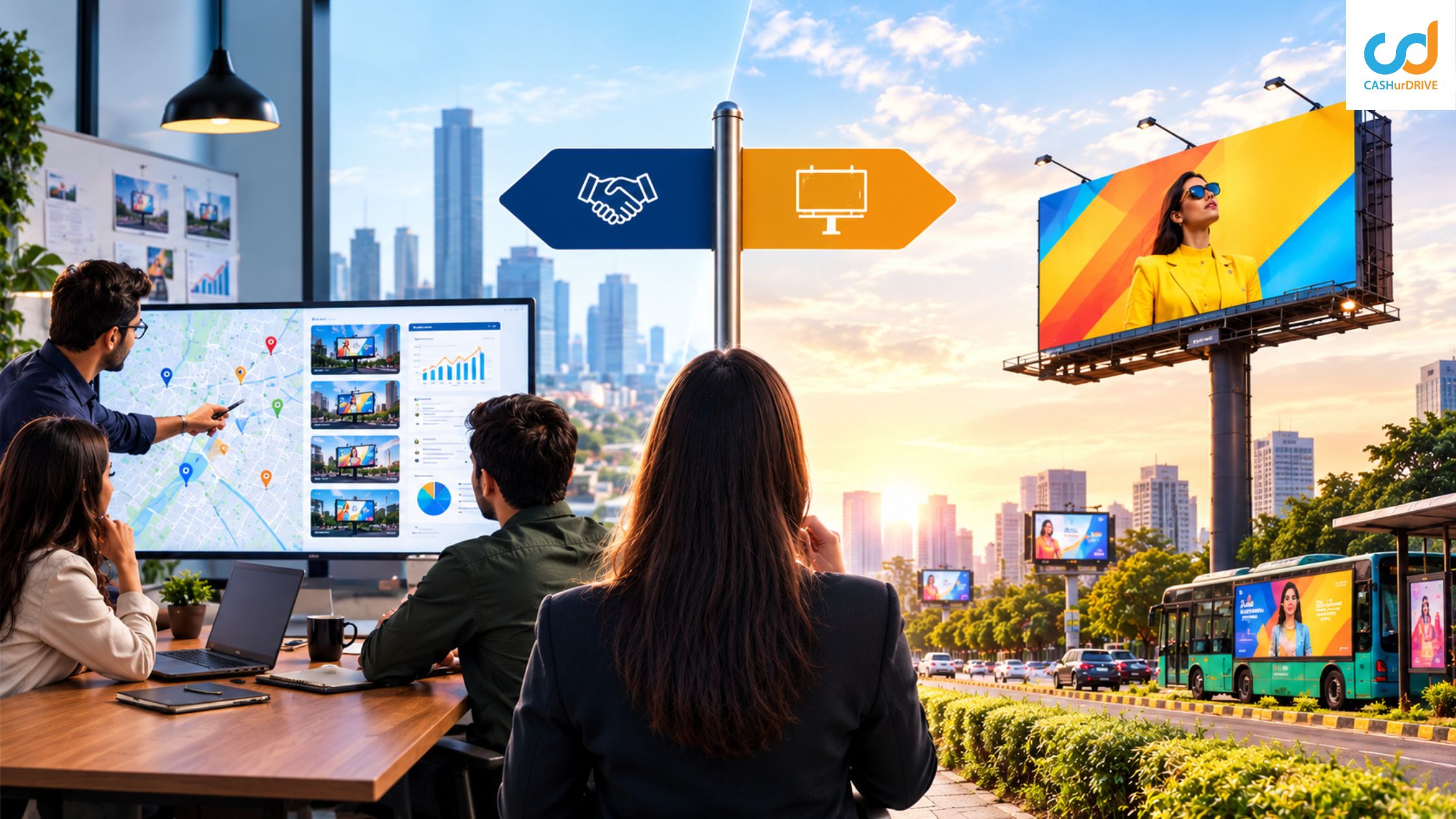
Outdoor Advertising Agency vs Media Owner: Which Should Your Brand Book Through?
 By Annu
An outdoor advertising agency is a planning and buying intermediary. It sources OOH media space on a brand’s behalf. A media owner, by contrast, operates its own advertising sites directly.
The outdoor advertising agency vs media owner choice affects your campaign in three ways. It changes the inventory you can access. It changes the data you receive. And it changes what you pay for the same site.
In India’s OOH market, both models are active. Agencies aggregate inventory from multiple operators. Media owners like CashUrDrive sell their own sites directly across Delhi NCR, Mumbai, Bangalore, and Pune.
Neither model is better in every case. The right choice depends on campaign scale, the planning support you need, and how much cost transparency you want.
This guide covers both models. It explains what each one gives you, and when the distinction stops mattering.
What an Outdoor Advertising Agency Does
An outdoor advertising agency acts as a planning and negotiation layer. It maps sites across multiple operators, proposes a plan, negotiates rates, and manages the campaign for the brand.
For brands running campaigns across several cities, this aggregation is the main value. One agency brief can cover billboards, transit, metro, and DOOH advertising from different operators under one contract.
Agencies also bring planning expertise. They know format-level reach estimates, seasonal availability, and how OOH fits a broader media mix. For brands without an in-house OOH specialist, this knowledge is useful.
However, agencies earn a margin on the media they buy. This margin is sometimes disclosed, sometimes not. The brand sees a proposal with media costs, but the rate paid to the media owner is often different. Access to a specific operator’s best sites also depends on existing agency relationships.
Reporting through an agency is filtered. Post-campaign data passes from the media owner to the agency before it reaches the brand. Each step is an opportunity for information to be summarised rather than shared in full.
What a Media Owner Offers
A media owner operates its own inventory. It controls the sites, the booking process, the installation, and post-campaign reporting from one point of accountability.
Direct booking removes the agency margin. When a brand books directly, the rate it negotiates is what the media owner receives. The brand pays that rate with no markup in between.
Media owners also have direct sight of site-level data. Footfall near the site, traffic counts on the route, and audience profile data all come from the operator itself, not a third-party aggregator.
The limitation of a media owner is scope. One operator’s inventory covers the cities and formats it physically runs. For a pan-India campaign across 15 cities and five format types, one media owner may not have full coverage. The brand may need to work with multiple operators or bring in an agency.
Still, for campaigns focused on one or two cities, direct booking is usually more cost-efficient. It also produces more detailed campaign data.
Outdoor Advertising Agency vs Media Owner: Five Key Differences
Inventory access
An outdoor advertising agency aggregates inventory from multiple media owners. It can propose sites across a wider geography in one plan. A media owner offers sites only within its own network. For campaigns needing broad spread across many operators, an agency saves significant coordination time.
Cost transparency
Direct booking with a media owner gives the brand a clear view of site costs. Agency fees and margins are not always disclosed in full. The effective cost per site can be higher than a direct rate. Brands that book OOH regularly tend to get better rates through direct relationships over time.
Planning and audience data
Agencies bring cross-format planning experience. However, site-level audience data is strongest at the media owner level. It comes from that operator’s own measurement systems. A media owner with an audience intelligence platform can verify who is at a site before the campaign brief is written.
Execution accountability
When something goes wrong, a direct media owner relationship resolves it faster. There is no intermediary to coordinate through. The operator owns the site, the installation team, and the relationship with the brand. Agencies add a coordination layer that can slow down the resolution of operational issues.
Reporting and post-campaign data
Post-campaign reporting is more detailed from a direct media owner. Data from the operator reaches the brand directly, with fewer hands in between. Agencies consolidate data from multiple operators into one report. That is convenient, but it loses site-level detail in the process.
When to Use an Agency
An outdoor advertising agency is the right model when the campaign needs inventory from more operators than an in-house team can manage. A national launch across 20 cities, or a multi-format campaign covering airport, metro, and large-format OOH simultaneously – these are cases where agency aggregation earns its fee.
Also, if the internal team lacks OOH planning experience, an agency provides a structured brief process, site selection rationale, and media math that would otherwise need to be built in-house.
The agency model also works well when the brand wants a single point of billing. Consolidating invoices and contracts from multiple operators is a real operational convenience for large marketing teams.
When to Book Directly with a Media Owner
Direct booking makes more sense when the campaign is concentrated in one or two cities where a media owner has strong inventory. It also makes sense when cost transparency is a priority, or when the brand wants site-level audience data.
For repeat advertisers, direct relationships with key media owners produce better rates over time. Volume committed directly to one operator gives that operator a reason to offer preferential access to premium sites.
Brands that need specific formats also benefit from booking direct. A transit campaign on particular metro corridors, or a cab-wrap campaign on specific urban routes, works better when the brand deals directly with the operator that controls that inventory.
CashUrDrive operates OOH advertising across Delhi NCR, Mumbai, Bangalore, and Pune. It offers direct inventory across billboard, transit, DOOH, metro, and cab formats. Brands booking directly access site-level Atlas audience data, not aggregated estimates.
How Intelligence Changes the Calculus
The trade-off between agency planning breadth and media owner data depth is narrowing. Media owners that invest in audience intelligence now offer something different. They combine verified site- audience data with direct inventory access and execution control.
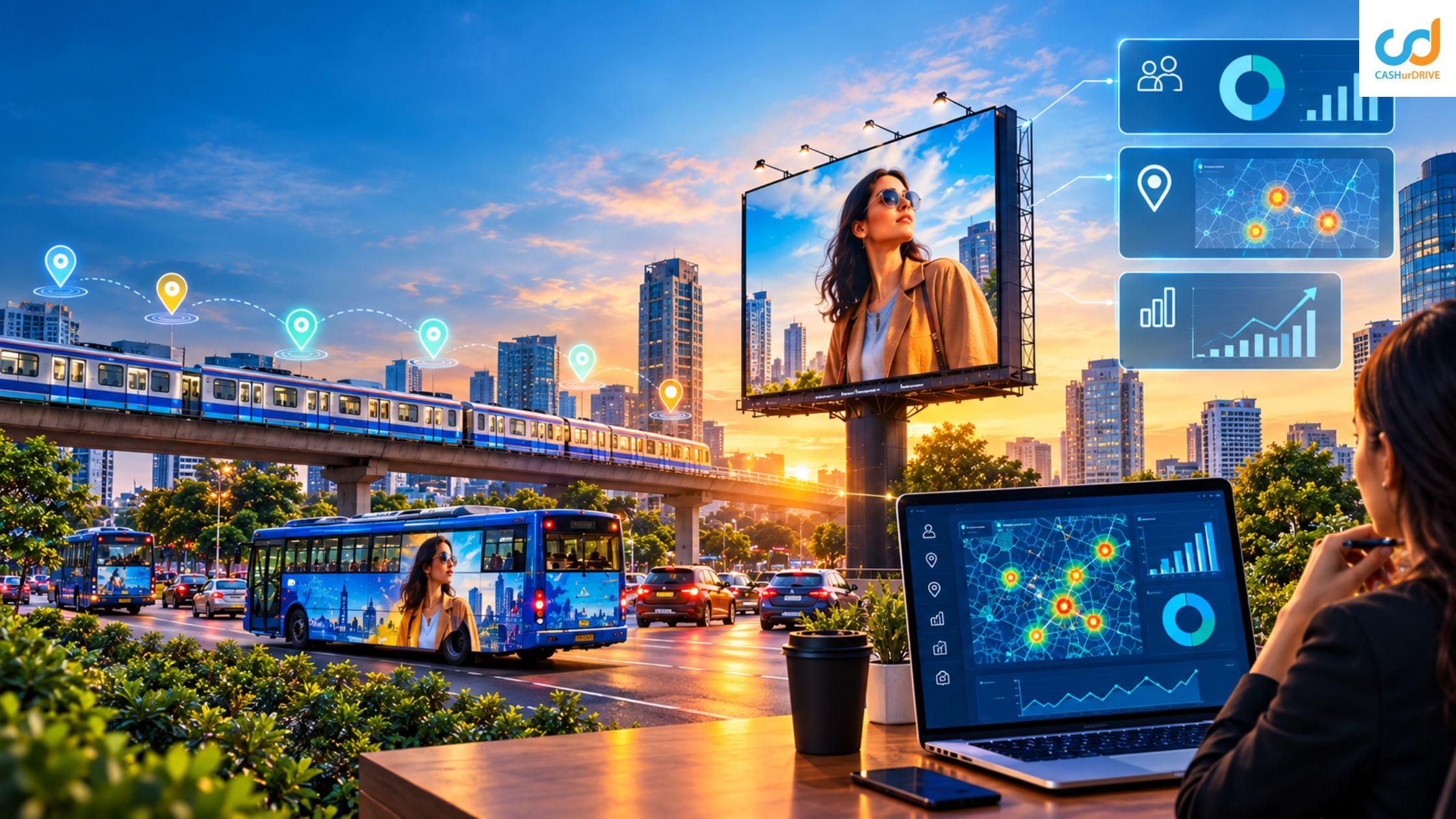
CashUrDrive’s Atlas platform uses device-level geofencing, Real-World Intelligence scoring, and NCCS profiling. It verifies who is passing a site before the campaign is booked. This is the kind of pre-campaign verification that used to require a separate data layer or a specialist agency.
When a media owner can show which of its sites over-index for urban professionals aged 28 to 40, the planning gap that justified agency fees shrinks considerably.
Post-campaign attribution from Atlas tracks footfall and brand lift after the campaign runs. Brands receive the accountability data they expect from a performance channel, applied to an OOH campaign.
Brands considering outdoor advertising services in India can request a pre-campaign Atlas audience map. It shows verified audience profiles at proposed sites before the media plan is finalised.
Frequently Asked Questions
Q1: What is the difference between an outdoor advertising agency and a media owner?
An outdoor advertising agency is an intermediary that plans and buys media space from multiple operators on a brand’s behalf. A media owner operates its own outdoor advertising sites and sells inventory directly. Agencies offer broader geographic coverage and cross-format planning. Media owners offer direct rates, site-level data, and single-point accountability for the inventory they control.
Q2: Does booking through an agency cost more than booking directly with a media owner?
Booking through an agency typically adds a margin above the media owner’s rate. Agency margins in India’s OOH market generally range from 10 to 20 percent of media value, though disclosure practices differ. Direct booking removes this layer. For campaigns in cities where one operator has strong inventory, direct booking usually produces a lower effective cost per site.
Q3: When should a brand use an outdoor advertising agency?
A brand should use an outdoor advertising agency when the campaign needs sites from many different media owners across multiple cities. Agencies also earn their value when the internal team lacks OOH planning experience, or when the brief spans several formats at once. For campaigns contained within one or two cities, direct booking is usually more efficient.
Q4: What data does a media owner provide that an agency cannot?
A media owner with an audience intelligence platform can provide site-level audience data verified from device movement and location signals. CashUrDrive’s Atlas platform verifies which audience segments are present at each site using geofencing and NCCS profiling. This site-level precision is typically not available through agency plans, which consolidate data from multiple operators into aggregated reach figures.
Q5: Can a media owner also help with campaign planning?
Yes. Media owners in India increasingly offer planning support, particularly those with audience intelligence systems. CashUrDrive’s Atlas platform supports pre-campaign audience verification, site selection based on verified audience density, and post-campaign attribution reporting. A brand can work directly with a media owner and still receive the planning and data layer previously only available through an agency.
Q6: How do I decide on the outdoor advertising agency vs media owner model for my campaign?
Start with campaign scope. The outdoor advertising agency vs media owner decision comes down to how many cities you need, how much site-level data you want, and how much cost transparency matters to your planning process. For campaigns in one or two cities with a clear format set, booking directly with a media owner is usually more efficient. For broad, multi-city briefs, an agency saves coordination time.
Conclusion
The outdoor advertising agency vs media owner question has no single right answer. Agency aggregation suits complex, multi-city campaigns that span many operators. Direct booking suits focused campaigns in cities where one operator controls the right inventory.
The distinction matters less when a media owner also offers planning capability. A media owner with audience intelligence, pre-campaign site verification, and post-campaign attribution reporting covers the gap that used to justify agency fees. It also keeps the cost transparency and accountability of a direct relationship.
Request an indicative media plan from CashUrDrive for your next outdoor campaign. Atlas identifies the sites where your target audience is verified to be present, across compare outdoor advertising agency quotes before making a final booking decision.
Author: CashUrDrive Editorial Team
Role: OOH Media Intelligence & Content
AI Disclosure: This article was produced with AI assistance and reviewed by the CashUrDrive editorial team.