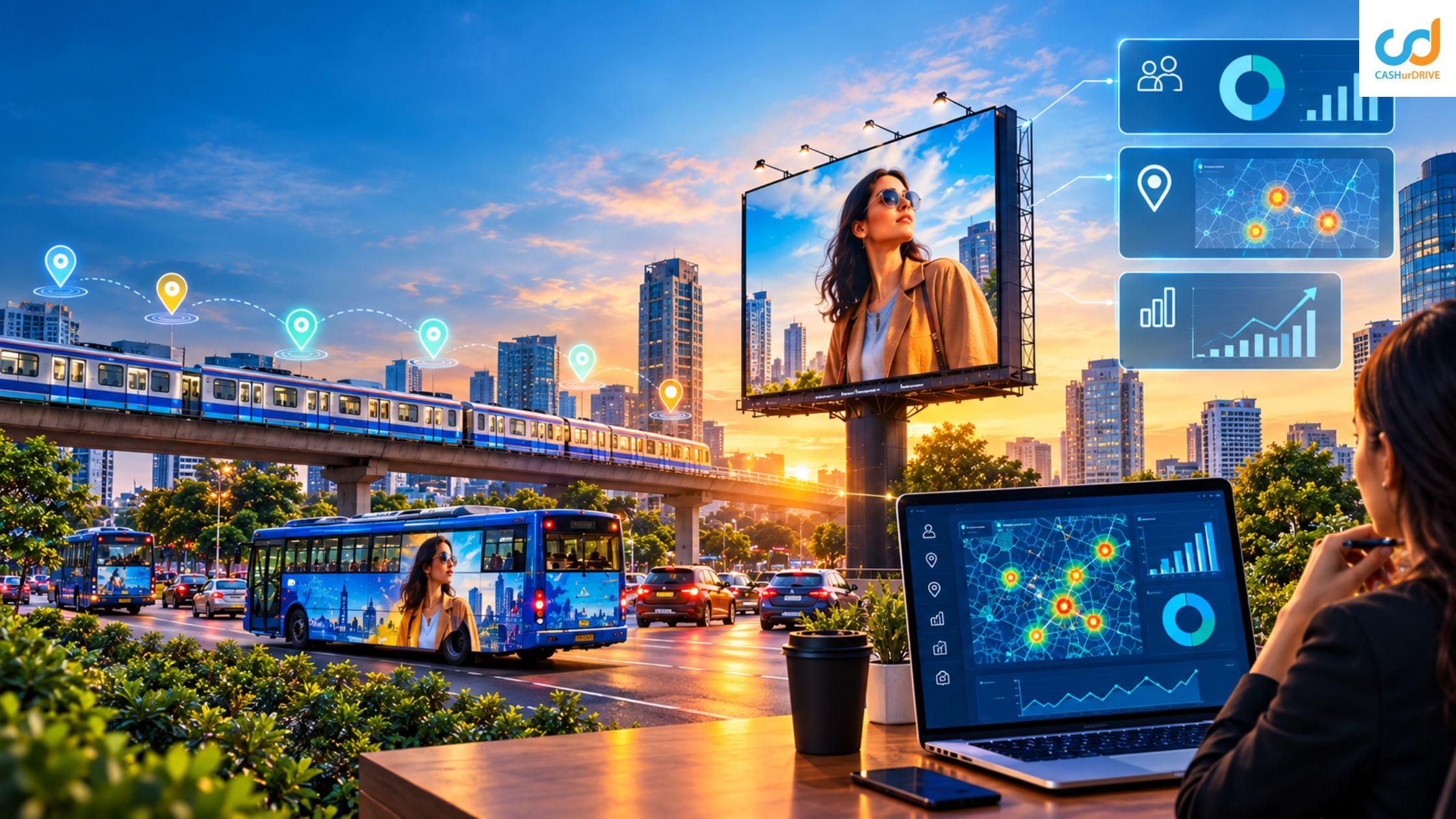
Why OOH Media Buying Is Becoming Data-Driven in India
 By Annu
Data-driven OOH media buying is a way to plan outdoor campaigns around audience data. It replaces the old habit of buying from site lists and rate cards. In India, this shift is already changing how brands brief, buy and judge the medium.
The reason is simple. Marketing leaders now ask every channel the same three questions. Who saw it? How often? Did it move anyone to act? Data-driven OOH media buying answers those questions with audience evidence, both before and after the campaign.
In fact, the Pitch Madison Advertising Report 2026 notes that DOOH now links more often with retargeting and data triggers.
This guide explains why the shift is happening now. Next, it shows what the new buying process looks like. Finally, it covers what changes for brands that sign off OOH budgets.
What Is Data-Driven OOH Media Buying?
Data-driven OOH media buying starts with the audience the brand wants to reach. The plan then works back to the hoardings, routes, stations and screens that audience passes. Each site earns its place on proof of who passes it, not on size or habit.
The older model worked the other way round. For example, an agency shared a list of sites with sizes, rates and photos. The brand then picked the busiest junctions it could afford. Reach came from traffic estimates. Proof of delivery was often a photo of the flex on day one.
That model still suits some briefs, such as a launch that needs pure scale. However, it struggles with the proof that finance teams now expect. After all, digital has trained them to ask for audience proof. Without it, OOH budgets become harder to defend in a planning review.
Our earlier piece on how data is changing billboard advertising looks at the billboard side of this. This guide looks at the buying process across every format.
Why the Shift Is Happening Now
Three forces are pushing Indian OOH toward data at once. Each one, on its own, would change buying habits. Together, they make the shift hard to reverse.
1. The Money Is Moving to Screens
According to the Pitch Madison Advertising Report 2026, Indian OOH revenue grew 4% in 2025 to ₹4,835 crore. Over the longer term, PwC’s Global Entertainment & Media Outlook 2025-29 expects DOOH to gain ground. It projects DOOH’s share of India’s OOH revenue to rise from 28.8% in 2024 to 44.1% by 2029. Screens can change creative by hour, place or audience. That makes them a natural fit for this kind of buying.
2. Measurement Is Catching Up
The World Out of Home Organization released its Global OOH Audience Measurement Guidelines 2.0 in June 2026. They show more markets now using phone movement data as their main input. India features too. According to WOO, RoadStar measures 300,000 sites across 2,300 cities from one data stream.
3. Buyers Expect Digital-Style Proof
CMOs now judge OOH against channels that report results daily. Therefore, a plan that cannot show who it reached is at a disadvantage in budget talks. Audience data closes that gap. It does so without changing what OOH does best.
How Data-Driven OOH Media Buying Works in Practice
In practice, the change shows up at four points in the campaign. Each step adds evidence the old model did not have.
Step 1: The Brief Starts With an Audience
The brand describes the people it wants to reach. For example, the target could be office staff in Gurugram, students in North Campus, or families in Navi Mumbai. Planners then map where those people move during the campaign window.
Step 2: Sites Get Checked Before Booking
Next, device-level data shows which audience segments pass each hoarding, station or route. Say a fintech brand wants young earners. It can see which corridors they use before it books anything. Sites that miss the audience drop off the plan early.
Step 3: The Buy Flexes in Flight
Once early data comes in, planners can shift DOOH advertising dayparts or move transit routes. Our guide to programmatic DOOH in India covers the automated side of this in detail.
Step 4: Results Are Judged on Outcomes
Finally, the brand measures what happened after exposure. Store footfall and brand lift sit alongside impressions. That gives the next plan a real baseline instead of a guess.
How Atlas Supports Data-Driven OOH Media Buying
At CashUrDrive, this is the work Atlas does. Atlas is CashUrDrive’s audience intelligence platform for OOH planning and measurement. It applies the four steps above to every format the company runs.
Here is a simple case. A D2C brand wants to reach young women in South Delhi before a sale. Atlas shows which metro exits, mall corridors and auto routes those buyers use most. The plan then uses those sites first, and drops the ones that look busy but draw the wrong crowd.
First, device-level geofencing shows who passes a site before the brand commits budget. Then NCCS profiling maps those audiences to the segments the brand targets. After launch, post-campaign attribution tracks footfall and brand lift among the people who saw the campaign.
The format list stays familiar: hoardings, transit media advertising, DOOH screens and metro train advertising. What changes is the evidence behind each line in the plan. In addition, the same method runs in Delhi NCR, Mumbai, Bengaluru and Pune. That lets a multi-city brand compare results like for like.
What Changes for Marketing Leaders
Data-driven OOH media buying does not make creative or scale less important. Instead, it gives both a sharper target. A strong idea in front of the right people is already valuable. With proof of what happened next, it also becomes a far easier budget to defend.
It also changes the questions worth asking a media partner. Ask how they verify the audience at each site before booking. Ask which outcomes they can measure after the flight. Then ask whether the method holds across cities, so results stay comparable.
The brands that move first will also set the benchmarks that others must meet. For that reason, 2027 planning is a good moment to test the approach on one city or one format.
A small test is enough to start. Pick one city, one format and one outcome to track, such as store visits. Then compare the result with a past flight bought the old way. That one test often settles the debate faster than any deck.
Frequently Asked Questions
Q1: What is data-driven OOH media buying?
Data-driven OOH media buying is a way to pick outdoor sites by audience data, not by size or rate card alone. Planners start with the target audience and find the hoardings, routes and screens it passes. In India, CashUrDrive’s Atlas uses geofencing and NCCS profiling. It checks each site before the brand books it.
Q2: Why is OOH media buying becoming data-driven in India?
OOH media buying in India is becoming data-driven because spend, measurement and buyer expectations are all shifting together. PwC projects DOOH’s share of Indian OOH revenue to rise from 28.8% in 2024 to 44.1% by 2029. In addition, systems such as RoadStar now measure audiences at scale. CMOs also expect OOH to report results like digital channels.
Q3: How is OOH audience measured in India?
OOH audience measurement in India now counts people, not just sites. According to the World Out of Home Organization’s 2026 guidelines, India’s RoadStar system measures 300,000 sites across 2,300 cities. Operator platforms such as Atlas add device-level geofencing. That shows which audience segments passed a site during a campaign.
Q4: Does data-driven OOH buying replace creative and scale?
Data-driven OOH buying does not replace creative or scale. Instead, it points both at the right people. A strong creative idea still drives attention, and large formats still build presence. Audience data simply makes sure that attention lands on the brand’s buyers, and it shows what happened after exposure.
Q5: What should brands ask an OOH partner about data?
Brands should ask an OOH partner three things about data. First, how they verify the audience at each site before booking. Second, which outcomes, such as footfall or brand lift, they measure after the flight. Third, whether the same method works across cities like Delhi NCR, Mumbai and Bengaluru, so results stay comparable.
Conclusion
Data-driven OOH media buying moves the medium from buying sites to buying audiences. Spend is shifting to screens, and measurement is catching up across India. Buyers also expect proof. Together, those forces make audience data the new starting point for every OOH plan.
CashUrDrive runs OOH, transit, metro and DOOH campaigns with Atlas audience data behind every site. Request a free Atlas audience map for your next OOH campaign. You will see who passes each site before you commit a rupee of budget.
Author:
CashUrDrive Editorial Team.
AI Disclosure: This article was produced with AI assistance and reviewed by the CashUrDrive editorial team.