Bus Advertising vs Cab Advertising: Which One Delivers Better Value for Your Campaign?
 By Annu
Two transit proposals land on your desk. One offers 20 wrapped buses for the month. The other offers 50 branded cabs for less money. The cab deal looks cheaper, and it also covers more vehicles. So it wins, right?
Not necessarily. When you compare bus advertising vs cab advertising on price per vehicle, you compare the wrong thing. A bus and a cab move through a city in different ways, so the same rupee buys a different kind of presence. What matters instead is how much of that presence lands where your customers actually are.
This guide explains how each format behaves on the road, how to compare value fairly, and which checks decide whether a proposal delivers.
How buses and cabs move through a city, and why it changes who sees your ad
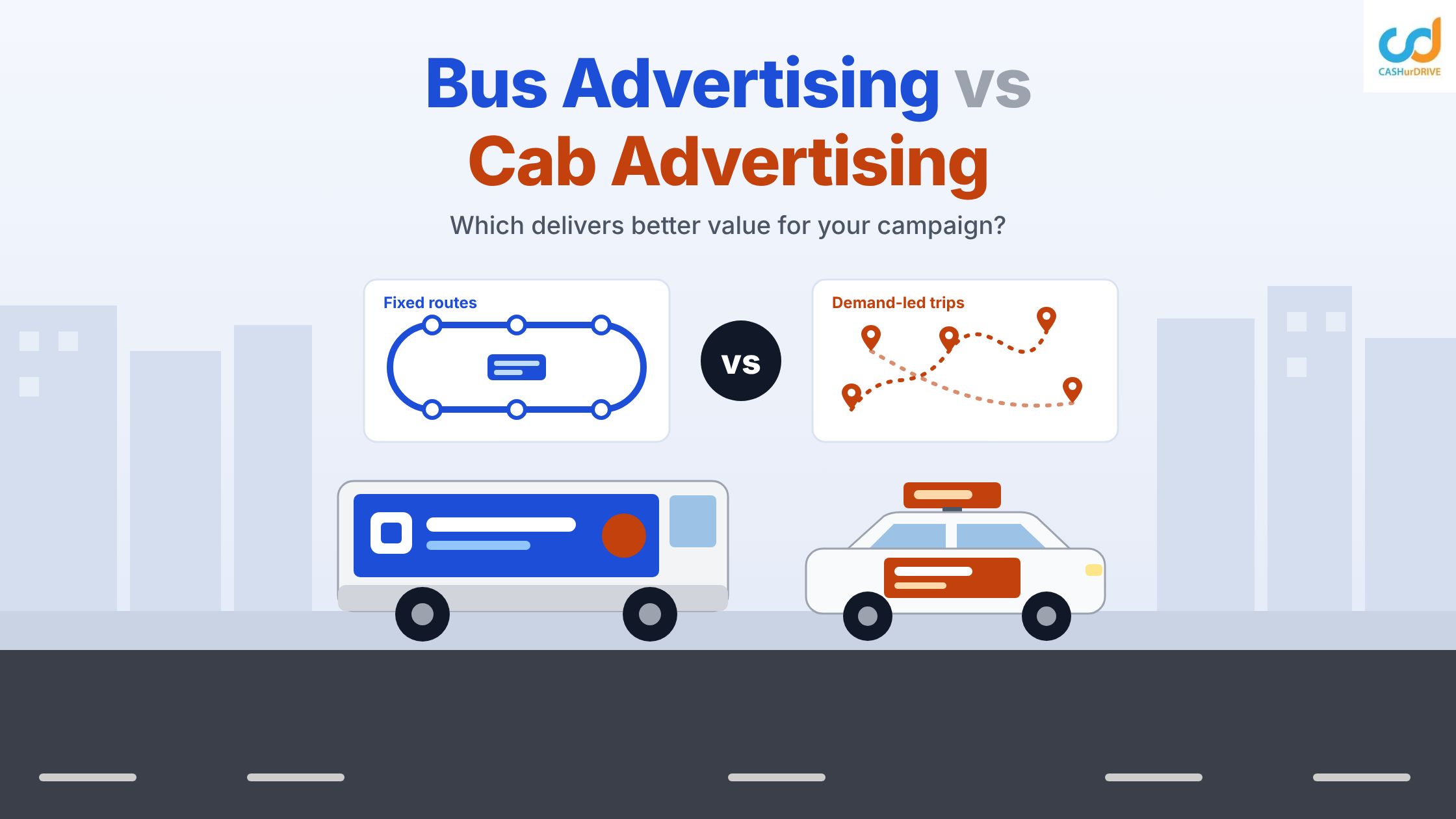
A city bus runs on schedule. It leaves a fixed depot, follows set routes and then repeats them through the day. Bengaluru’s BMTC, for example, ran 6,272 services and 67,841 trips a day across a fleet of 6,955 buses, as reported in August 2026. For an advertiser, that schedule is the point. As a result, if you know the routes, you know which roads, junctions and neighbourhoods will see your wrap, and how often.
A cab follows demand instead. It goes wherever the next passenger wants to go, so its exposure clusters around airports, railway stations, business districts and late-evening hotspots. That reach can be valuable, but it is hard to steer. For example, on a given day, a branded cab may spend hours in your target area or almost none.
In addition, the viewing context differs. People mostly see a bus wrap from the street, at bus stops and at signals. A cab adds an interior: the passenger sits with seat-back or in-cab branding for the whole ride, which suits messages that take a few seconds to read.
Bus advertising vs cab advertising at a glance
The table below compares bus advertising vs cab advertising on the factors that usually decide a plan. It does not name a winner, because the right choice depends on your objective. In practice, the bus branding vs cab branding decision often comes down to how much route control you need.
|
Factor |
Bus advertising |
Cab advertising |
|
Coverage pattern |
Repeated exposure along fixed corridors | Scattered exposure, since trips follow passenger demand |
|
Route control |
High, especially if you choose depots or routes | Low with aggregator fleets, but higher with a dedicated fleet |
| Canvas size | Large side and rear panels, or a full wrap |
Doors, rear and boot; also roof-top units where permitted |
|
Viewing context |
Pedestrians, other road users, people at stops | Road users outside, while a passenger sits inside |
|
Interior options |
Panels for bus commuters |
Seat-backs and in-cab material for one passenger |
|
Typical scale |
Fewer vehicles, but each very visible | More vehicles, though each is smaller |
| Flexibility | Tied to operator tenders and contract terms |
Often easier to add or drop vehicles, though it depends on the vendor |
| Permissions | Set by the operator, transport authority and sometimes traffic police |
Set by the state transport authority, so rules vary by state |
| Proof of display | Photos plus route and depot records |
Photos plus trip or GPS logs |
For other formats, see the options for transit media advertising.
Compare cost per relevant vehicle-day, not cost per vehicle
The fairest way to compare bus advertising vs cab advertising proposals is to ask a simple question. How many days of vehicle presence does each one put inside your target zones, and what does each of those days cost?
Here is a worked example. Illustrative, not market rates. Every figure below is an assumption.
Proposal A: bus wraps
- 20 buses at an assumed ₹40,000 per bus per month = ₹8,00,000.
- Buses available on 27 of 30 days, allowing for maintenance and breakdowns.
- The assigned routes spend 70% of operating time inside your target zones.
- Relevant vehicle-day equivalents = 20 × 27 × 0.70 = 378.
- Cost per relevant vehicle-day = ₹8,00,000 ÷ 378 = about ₹2,116.
Proposal B: cab branding
- 50 cabs at an assumed ₹12,000 per cab per month = ₹6,00,000.
- Cabs on the road on 26 of 30 days, allowing for drivers’ days off.
- Trips spend 20% of their time inside your target zones.
- Relevant vehicle-day equivalents = 50 × 26 × 0.20 = 260.
- Cost per relevant vehicle-day = ₹6,00,000 ÷ 260 = about ₹2,308.
When the bus advertising vs cab advertising answer flips
The cheaper proposal is thus the more expensive one per useful day. Then change one thing. Suppose the operator assigns the buses to a different depot, and their routes spend only 35% of the time in your zones. Relevant vehicle-day equivalents fall to 20 × 27 × 0.35 = 189, and the cost rises to about ₹4,233 per day. Therefore, the cabs now win comfortably.
Besides, downtime is real, not theoretical. When Delhi’s DTC tendered wrap advertising on its electric buses, it charged the licence fee on only 90% of the fleet to allow for downtime. So ask every vendor what availability their price assumes.
Still, a relevant vehicle-day is a starting point, not the final answer. A bus side is a bigger canvas than a cab door, and a cab interior gives you a seated reader. Use the calculation to remove the misleading per-vehicle comparison, then weigh canvas size and context against your creative.
Match the format to your campaign objective
When choosing between bus advertising vs cab advertising, start with what the campaign must achieve, then let the format follow.
| Objective | Lean | Why |
| City-wide awareness | Mix | Buses give repeated presence on major corridors; meanwhile, cabs fill in areas and hours the routes miss |
| One corridor or locality | Bus | Because routes are chosen, the same streets see the message daily |
| Airport and business-district audiences | Cab | Demand-led trips especially concentrate around these hubs |
| Footfall near specific stores | Bus | Routes can also be matched to the roads that pass your outlets |
| A short burst around an event | Cab | Vehicles are often quicker to add or drop than bus contracts allow |
| Multi-city consistency | Mix | Bus inventory depends on each city’s operator and tender, so cabs can fill the gaps |
Two hypothetical briefs, worked through
Hypothetical brief 1: a clinic chain. A chain has eight branches along two arterial roads in one city. Its customers also live and travel along those roads. Bus advertising fits best, but only if the buses run routes that pass the branches. The plan should therefore name the depots and routes, not just the number of buses.
Hypothetical brief 2: an app launch. A new app targets office commuters and frequent flyers across a city. Its audience is spread out but gathers at business districts and the airport. Cab advertising therefore fits better, with interior placements carrying a short reason to download. Meanwhile, a small number of buses on routes through the main business district could add repeated presence.
Five operational checks that decide real value
In practice, two proposals can look identical on paper and deliver very different campaigns. Any transit media format comparison should include these five checks before you sign.
- Which panels are permitted. Rules vary by city and vehicle. In Delhi, the traffic police objected to advertising on the right side of DTC buses because it could distract motorists. In Goa, a transport department circular reported by Herald Goa allowed cab ads only on the rear, left and right sides, covering no more than 75% of each side and never the windscreens; confirm the current conditions with the department before you plan. Karnataka’s rules require Regional Transport Authority approval before any transport vehicle carries an ad.
- Which vehicles you actually get. Ask for the depots, routes or fleet the vehicles belong to. In Mumbai, BEST ran 2,834 buses as of September 2026, and most were operated by private contractors, so confirm who holds the advertising rights for the buses on offer.
- Uptime and replacement. Ask what happens when a branded vehicle is off the road, and whether the vendor replaces it or credits you.
- Creative made for each canvas. A bus side and a cab door need different layouts, so adapt the artwork to each format instead of stretching one design across both.
- Proof of display. Ask for dated, geotagged photos at installation and during the campaign, plus route records for buses or trips and GPS logs for cabs.
When a mix beats either format alone
Overall, many campaigns do better with both. Buses build repeated presence on the corridors that matter most, while cabs reach the hubs, neighbourhoods and late hours the bus routes miss. The key, however, is to plan both against the same map of target zones, so the two formats complement each other rather than overlap.
If you are weighing bus advertising vs cab advertising for your next campaign, request an indicative media plan or format guidance from CashUrDrive for your cities and objectives.
Frequently asked questions
Bus advertising vs cab advertising: which is cheaper? Not in any way that helps you decide. Instead, compare what each proposal costs per day of presence inside your target zones, after allowing for downtime.
Q1: Can I choose specific bus routes?
Often you can choose depots or routes, depending on the operator’s contract and available inventory. Ask for this in writing before approval.
Q2: Can cab ads target one area?
Only loosely with aggregator fleets, because cabs follow passenger demand. By contrast, a dedicated fleet, or a share of cabs that operates mainly in one zone, gives more control.
Q3: Do ads on buses and cabs need permission?
Yes, because transport authorities regulate ads on transport vehicles, and the rules differ by state, covering which sides and how much area you can use.
Q4: Which format suits a two-week campaign?
Generally, cabs are easier to add for short bursts. By contrast, bus contracts, tender terms and installation time can make very short bus campaigns harder to arrange.
Q5: How do I check the ads actually ran?
Ask for dated, geotagged photos and route or trip logs during the campaign, not just at launch. These checks also apply to all cab advertising formats, from door panels to interiors.
AUTHOR:
CashUrDrive Editorial Team
This article was produced with AI assistance and reviewed by the CashUrDrive editorial team.