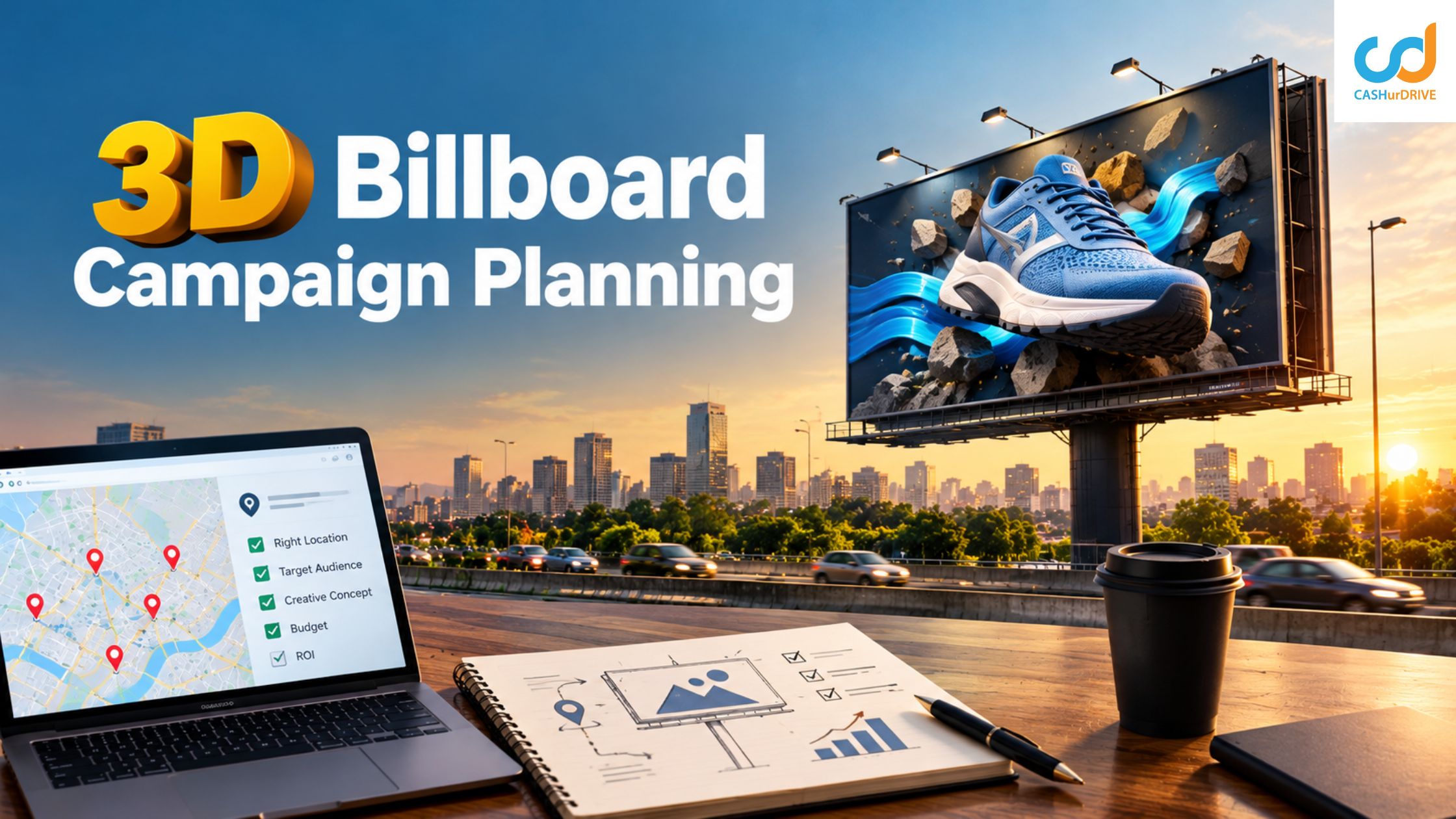
3D Anamorphic OOH Advertising in India: How Brands Create Social-Media-Worthy Campaigns
 By Annu
3D anamorphic OOH advertising is a large-format outdoor technique that uses forced perspective to make digital billboard content appear three-dimensional to viewers standing in front of the screen.
The effect works without special glasses. The content appears to push out of the screen boundary or descend into the ground below it.
The format went global in 2021 and 2022, when brands in South Korea, Japan, and China created billboard moments that millions of people shared across social media.
Indeed, the social amplification is the primary reason brands invest in the format. The paid reach is one number. The earned reach from social sharing is often a much larger one.
3D anamorphic OOH ads is now reaching Indian cities. Brands running immersive outdoor campaigns in Mumbai, Delhi, and Bangalore are beginning to use the format for high-visibility launches.
This guide covers how the technique works, what global campaigns have done with it, and how Indian brands can plan a campaign around it.
How 3D Anamorphic OOH Works
The anamorphic effect relies on forced perspective. Content creators design video in which objects appear to push toward a single viewing point. The screen is flat. The content, however, is rendered at an angle.
When a viewer stands at the correct position in front of the display, depth and movement appear real. The brain perceives a three-dimensional object because the perspective cues match those of real-world depth.
3D outdoor ads of this type works best on large LED screens with fine pixel pitch. A pixel pitch of P4 or finer gives enough resolution for the perspective render to read clearly at distance.
Corner screens work especially well. However, flat single-panel screens can also carry the effect when they are large enough and the content is designed for a single fixed viewpoint.
The viewing angle is calibrated during the content brief. Most anamorphic content is designed for audiences standing 10 to 30 metres from the screen. Outside that range, the perspective effect weakens.
Still, even audiences outside the optimal viewing zone can perceive the content as unusual. This draws them toward the screen and toward the sweet spot.
Why the Format Drives Social Sharing
The anamorphic effect surprises viewers. People encounter thousands of advertising impressions per day. A billboard that appears to physically extend into real space stops that routine.
Furthermore, the content is designed to be filmed. The three-dimensional illusion only reads clearly through a camera lens or a phone screen held at the correct angle.
This creates a natural filming behaviour. Pedestrians stop, hold up their phone, and capture the moment. The result is organic video content shared to Instagram Reels, YouTube Shorts, and social feeds.
According to Talon OOH’s 2026 effectiveness research, OOH campaigns that generate social-first creative achieve significantly higher earned media reach above their paid placement reach. Anamorphic content is the format best positioned to generate this social layer.
Also, the content typically runs in loops of 15 to 30 seconds. This keeps the filming moment short enough to capture and share without editing.
Consequently, the campaign’s effective reach is the sum of direct footfall impressions and all social shares of filmed content from the site.
Global 3D Anamorphic Campaigns That Set the Standard
Samsung at Coex Artium, Seoul (2020)
Samsung’s activation on the Coex Artium curved screen in Gangnam, Seoul, was one of the first anamorphic OOH executions to be widely shared globally. The screen’s large curved format allowed wave and water effects to appear to spill over the building edge.
The content went viral across social platforms before anamorphic OOH was widely known as a category. It established the format as a brand tool rather than an art installation.
Nike Air Max Day, Seoul (2022)
Nike’s Air Max Day campaign in Seoul used anamorphic perspective to project a massive Air Max sole emerging from an LED screen. The campaign was reported by Campaign Asia and Creative Review as one of the most-shared OOH executions of 2022.
The social amplification from the Seoul activation reached audiences in markets where the physical billboard never appeared. Similarly, it generated editorial coverage worth far more than the media spend on the screen itself.
Coca-Cola Times Square 3D (2022)
Coca-Cola ran one of the first major anamorphic executions at Times Square, using a curved screen format to create a polar bear emerging from a Coke bottle. The execution was covered by Adweek and ran during the holiday season.
For example, this campaign demonstrated that the format could carry emotional and seasonal messaging, not only product launches or tech brand announcements.
3D Anamorphic OOH in India: What Brands Are Doing Now
Anamorphic DOOH in India is still an emerging format. The infrastructure it requires, large-format fine-pitch LED screens in high-footfall urban zones, is concentrated in a small number of locations.
However, the number of premium DOOH screens in Indian cities has grown significantly since 2023. Mumbai’s BKC and Andheri junction, Delhi’s Connaught Place and Aerocity, and Bangalore’s Whitefield corridor now carry screens capable of hosting anamorphic content.
Indian OTT and entertainment brands were the first to use the format at scale. Streaming platforms launching new original series have used large-format DOOH screens with perspective content to generate social media chatter at launch.
Additionally, Indian fintech and FMCG brands have started exploring the format for product launches that need urban visibility and social traction simultaneously.
CashUrDrive operates DOOH advertising inventory at premium urban locations across Mumbai, Delhi, and Bangalore. These sites include screen formats that support anamorphic content delivery.
Planning a 3D Anamorphic Campaign: What Brands Need to Know
Experiential outdoor advertising of this type requires three things to work: the right screen, the right creative, and the right location brief.
The screen must be large enough and fine enough in pixel pitch for the perspective render to read clearly. Most anamorphic content requires a screen of at least 10 metres wide and P4 pixel pitch or finer.
The creative brief must specify the viewing angle before content production begins. The render is built around a fixed viewer position. Changing that position after production means rebuilding the content.
The location brief must verify audience behaviour, not just footfall numbers. The optimal viewer position must be a place where pedestrians naturally pause. A high-speed road in front of the screen means the audience drives past the sweet spot without stopping.
Therefore, site selection for an anamorphic campaign is more precise than for a standard DOOH campaign. The screen matters. The space in front of the screen matters equally.
See CashUrDrive’s recent OOH campaigns for examples of experiential and high-impact outdoor formats in Indian cities.
How Atlas Improves 3D Anamorphic Site Selection
Anamorphic content production is expensive relative to standard DOOH creative. Brands invest in it precisely because the earned media return justifies the cost. However, that return depends entirely on the right screen being in the right place.
Atlas identifies, through device-level geofencing, which premium DOOH locations in a given city see the highest concentration of the target audience segment. Brands do not have to guess which BKC screen or which CP junction gets the right viewer profile.
Furthermore, Atlas identifies dwell time near each site. A screen beside a metro exit where commuters wait for cabs sees a very different audience behaviour than a screen on a high-speed arterial road.
Dwell time is what makes an anamorphic campaign work. The filming behaviour depends on people stopping for 15 to 30 seconds. Atlas data shows which sites naturally generate that behaviour.
According to Billups’ 2026 report, pre-campaign site verification through audience data lifts campaign match rates by 23%. For anamorphic campaigns where creative production cost is high, this verification step reduces the risk of investing in the wrong screen.
See more OOH campaign examples or get location recommendations for a 3D anamorphic brief from CashUrDrive’s planning team.
Also, review how to target audience with billboard advertising to understand how site-level audience verification improves outdoor campaign ROI across all formats.
Frequently Asked Questions
Q1: What is 3D anamorphic OOH advertising?
3D anamorphic OOH ads is a digital billboard technique that uses forced perspective rendering to make content appear three-dimensional when viewed from the front of the screen. The screen itself is flat. Content is pre-rendered at an angle that creates the illusion of depth, height, or objects extending beyond the screen boundary. The format works on large LED screens with fine pixel pitch, typically P4 or better, in high-footfall urban locations.
Q2: Which Indian cities support 3D anamorphic OOH campaigns?
3D anamorphic OOH campaigns in India can currently run at premium DOOH locations in Mumbai (BKC, Andheri), Delhi (Connaught Place, Aerocity), and Bangalore (Whitefield). These sites have large-format fine-pitch LED screens capable of delivering the resolution and screen size the technique requires. Additionally, as premium DOOH infrastructure expands in Pune and Hyderabad, more locations will support the format.
Q3: How much does a 3D anamorphic OOH campaign cost in India?
A 3D anamorphic OOH campaign in India involves two main cost components. First, the screen media cost, which ranges from Rs 2 to 8 lakh per month for premium large-format DOOH sites depending on city and location. Second, content production, which adds Rs 5 to 20 lakh for anamorphic video render and design, depending on complexity. The total is higher than a standard DOOH campaign. However, the earned media value from social sharing can significantly extend the campaign’s effective reach and lower the overall cost per impression.
Q4: Why do 3D anamorphic campaigns go viral on social media?
3D anamorphic campaigns go viral because the illusion reads most powerfully through a phone camera held at the correct angle. This creates a natural filming moment. Pedestrians stop, capture the content on their phones, and share it across Instagram Reels, YouTube Shorts, and Twitter. Consequently, the campaign generates earned media reach across digital audiences who never saw the physical billboard.
Q5: What screen specifications does 3D anamorphic OOH require?
3D anamorphic OOH requires a large-format LED screen with a pixel pitch of P4 or finer. The minimum recommended screen size is approximately 10 metres wide for the perspective effect to read clearly at standard pedestrian distance. Corner-wrap screens, where two panels meet at a building edge, work especially well because the geometry reinforces the three-dimensional illusion. Furthermore, the screen location must have an open pedestrian space in front of it where audiences can stop at the optimal viewing distance of 10 to 30 metres.
Q6: How does an anamorphic OOH campaign differ from standard DOOH?
Standard DOOH delivers a flat video or static image on a large screen. 3D anamorphic OOH delivers content specifically rendered to create a depth illusion from a fixed viewer position. The creative brief, production cost, and site selection process are all more complex. In return, the format generates higher audience attention and significantly more social sharing than a standard DOOH campaign. Indeed, the social amplification layer is the primary reason brands invest in the format over conventional digital outdoor.
Conclusion
3D anamorphic OOH advertising is the format that turns a single screen into a social media moment.
The technique requires precise site selection, careful creative briefing, and the right screen specification. When all three align, the paid media reach of one billboard generates earned media reach across millions of digital screens.
India’s premium DOOH infrastructure now supports the format in key cities. Brands planning high-visibility launches therefore have access to the same creative approach that produced some of the most-shared billboard campaigns of the last three years.
Atlas maps the audience density at every premium DOOH location in CashUrDrive’s inventory. Brands consequently choose their anamorphic screen based on verified audience data, not assumptions about which junction gets the most traffic.
Contact CashUrDrive for format and location recommendations for your next 3D anamorphic campaign brief.
Author: CashUrDrive Editorial Team
Role: OOH Media Intelligence & Content
AI Disclosure: This article was produced with AI assistance and reviewed by the CashUrDrive editorial team.