Cab Advertising Cost in India: Formats, Fleet Size and Coverage
 By Annu
A cab wrap on a high-traffic Delhi route generates an estimated 30,000-50,000 impressions per month. That is a fraction of the cost of a static billboard on the same corridor. Unlike a fixed hoarding, the medium moves. The same vehicle covers South Delhi in the morning, Gurugram by afternoon, and Noida by evening. This means three distinct audience segments see your brand in a single campaign day.
Cab advertising is a form of transit media advertising that places brand messages on the exterior or interior of app-based cab fleets, reaching urban commuters across multiple journeys on high-frequency city routes.
Cab advertising cost in India – quick answer
Full exterior wraps in Tier 1 cities cost approximately ₹8,000-₹14,000 per vehicle per month. Partial formats – door panels and boot wraps – range from ₹4,000-₹7,000. Interior seat-back panels start at ₹1,500. Total campaign spend is a function of format, fleet size, duration, and city. Rates are indicative as of 2026.
This guide covers cab advertising cost in India across each variable, so you can build a realistic budget before the media plan is written.
Cab Advertising Formats and What Each Costs
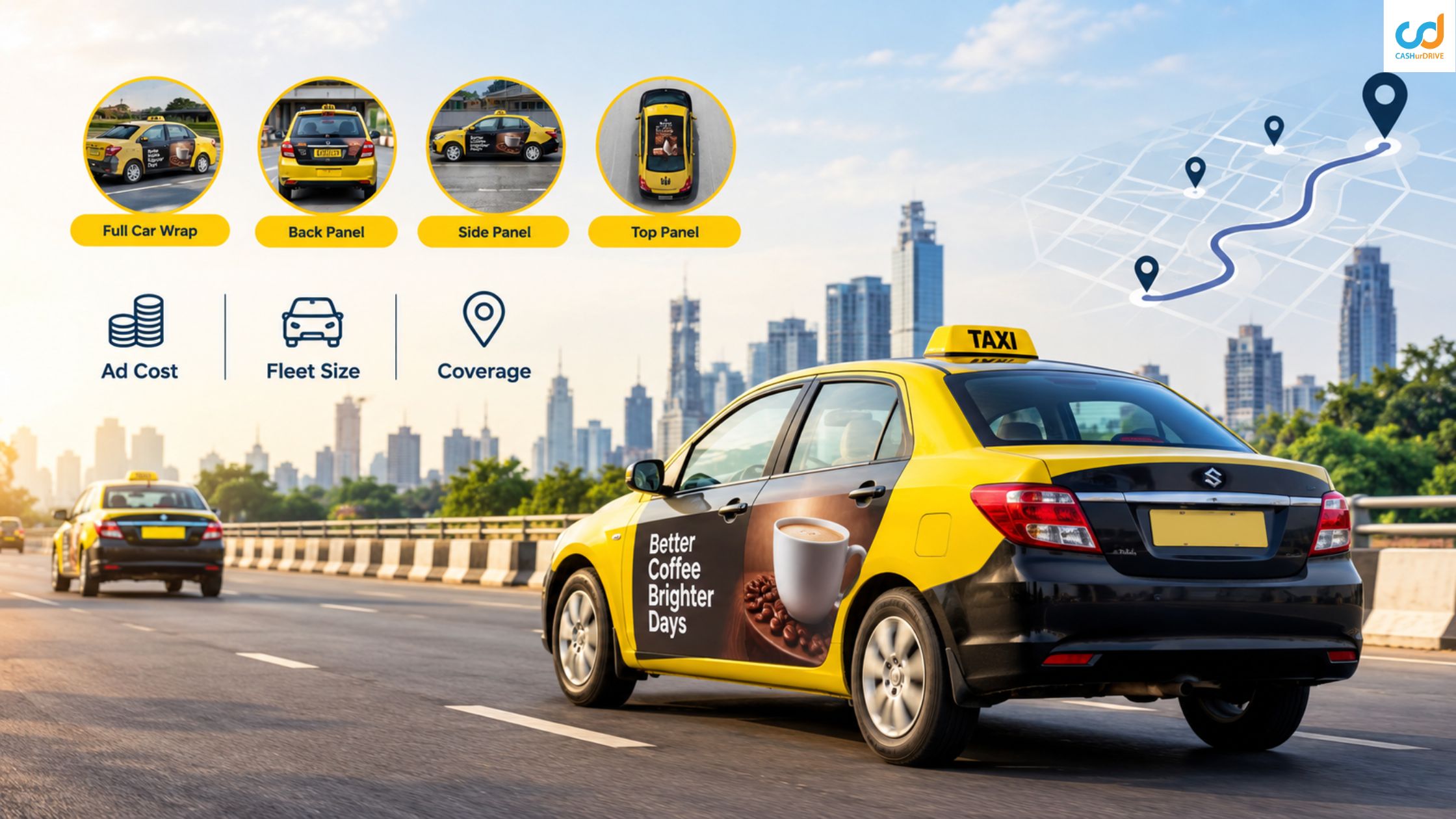
Cab advertising in India comes in three main formats. Each has a distinct cost range, a different creative requirement, and a different impression dynamic. Understanding these is the starting point for estimating cab advertising cost in India.
Full exterior wrap
A full wrap covers the visible exterior of the cab – both side panels, boot, and bonnet. It is the highest-visibility cab format. The creative is readable from pavement level, at traffic signals, and from adjacent vehicles. Full wraps work best for brand awareness campaigns where the message needs to land in under three seconds.
Indicative rate (2026, Tier 1 cities): ₹8,000-₹14,000 per vehicle per month
Partial exterior wrap – door panels or boot
Partial formats place the brand on specific panels rather than the full vehicle. For example, door panels reach pedestrians at close range. Boot wraps, on the other hand, are readable in stop-and-go traffic. Partial wraps lower the media cost per vehicle while keeping street-level visibility. They suit campaigns where impression volume at lower cost matters more than full creative coverage.
Indicative rate (2026, Tier 1 cities): ₹4,000-₹7,000 per vehicle per month
Interior seat-back panel
A seat-back panel sits on the rear face of the front passenger seat. Every backseat passenger sees it for the full journey. Average ride durations in Indian metros run 20-35 minutes. That is long enough for a passenger to read a QR code, recall a promo code, or engage with a longer message. Interior panels are particularly effective for app-install campaigns, fintech offers, and D2C brand discovery.
Indicative rate (2026, Tier 1 cities): ₹1,500-₹3,000 per vehicle per month
| Format | Indicative rate (per vehicle/month) | Best suited for |
| Full exterior wrap | ₹8,000-₹14,000 | Brand awareness, high-visibility launches |
| Door panel / boot wrap | ₹4,000-₹7,000 | Cost-efficient reach, tactical promotions |
| Interior seat-back | ₹1,500-₹3,000 | QR codes, app downloads, longer messages |
Rates are indicative for Tier 1 cities (Delhi NCR, Mumbai, Bengaluru) as of 2026. Tier 2 city rates are typically 20-30% lower.
▶ See CashUrDrive’s cab advertising formats and get indicative rates for your city
Key Factors That Determine Cab Advertising Cost in India
The rate per vehicle per month is the starting point. However, several other variables shape the final cab advertising cost in India.
City tier
Delhi NCR, Mumbai, and Bengaluru carry the highest rates. Tier 2 markets – Lucknow, Jaipur, Chandigarh, Kochi – typically cost 20-30% less for equivalent formats and fleet sizes. Pune and Hyderabad sit between the two brackets, with rates closer to metro levels on high-demand corridors.
Fleet size
Volume discounts are standard. A campaign booking 50 vehicles is priced differently from one booking 300. The per-vehicle rate drops meaningfully with scale. Most operators set a minimum fleet threshold of 50-100 vehicles. Below that threshold, fixed logistics costs – installation, monitoring, removal – are distributed across fewer cabs, which raises the rate per unit.
Campaign duration
Wrap production – printing and installation – is a fixed cost per vehicle. It does not change based on how long the campaign runs. As a result, spreading that fixed cost across 8 or 12 weeks produces a better effective cost-per-impression than a 4-week burst. Short campaigns are available. However, the economics of cab advertising favour runs of six weeks or longer.
Cab category
Standard hatchback and sedan fleets on Uber and Ola networks are the most cost-efficient option for most campaigns. Premium categories – Uber Premier, Ola Prime, corporate fleets – carry higher rates. That said, the premium is worth paying when the target audience is specifically upper-NCCS. Route targeting can then be calibrated to corporate campuses, airport corridors, and five-star hotel clusters.
Route and geography targeting
Open network distribution is the default. Cabs move freely across a city, and this is the most affordable option. Operators who offer corridor-specific targeting – airport routes, tech-park hubs, central business districts – charge a premium for that inventory. In practice, audience-targeted planning uses mobility data to identify which routes carry the highest density of the target audience. This approach typically reduces wasted impressions and improves campaign ROI.
How Fleet Size Changes Your Cost-Per-Impression
Impression volume in cab advertising scales with fleet size. However, it does not scale in a simple linear way. Each vehicle covers multiple zones in a single day. For example, the same cab may handle an airport pickup in the morning, serve a residential area in the afternoon, and cover a commercial hub by evening. This movement multiplier means that 200 cabs on a mixed urban network can deliver higher aggregate reach than 200 static hoardings at fixed locations.
India’s app-based cab market gives a sense of the available scale. Uber and Ola together operate over one million active vehicles across Indian cities. Delhi alone has well over 100,000 active ride-share vehicles on any given day. A fleet of 200 cabs represents a fraction of available inventory. This leaves significant room to scale for national campaigns.
At CashUrDrive, fleet selection is planned using the Atlas platform. Atlas maps observed movement patterns against a campaign’s target audience commute corridors before the fleet is booked. As a result, a 200-cab campaign on routes with high NCCS A/B audience density will consistently outperform 400 cabs on unfiltered network inventory. Reach quality, not just reach volume, determines campaign outcome.
▶ Request an Atlas audience map showing your target segment’s density on cab routes in your city – before the brief is written
City-Level Coverage: Where Cab Advertising Performs
Cab advertising is an urban transit format. Its effectiveness scales with city density and ride-share penetration. Both are highest in the major metros.
Delhi NCR
Delhi NCR is the largest active ride-share market in India. Cab routes cover South Delhi, Gurugram, Noida, Faridabad, and Ghaziabad. This gives a single campaign access to five distinct urban clusters. For brands targeting working professionals aged 25-45, the premium residential and commercial belt of Delhi NCR is particularly strong territory.
Mumbai
High-frequency routes between Bandra-Kurla Complex, Lower Parel, Andheri, and Navi Mumbai carry premium urban audiences. Unlike Delhi, Mumbai does not have a comprehensive metro network. As a result, cabs are a primary transport mode for working professionals making cross-suburb journeys. This makes Mumbai a high-value market for aspirational consumer brands.
Bengaluru
Tech campus corridors – Whitefield, Electronic City, Koramangala, HSR Layout – make Bengaluru one of the most valuable markets for FMCG, D2C, and fintech brands. The target audience is NCCS A professionals aged 25-40. In addition, average cab journey lengths in Bengaluru are among the longest in India because of traffic. Longer journeys mean more exposure time per impression.
Pune, Hyderabad, Ahmedabad
These are growing ride-share markets with lower inventory costs than the top three metros. They are well-suited to brands seeking regional reach at better cost-per-impression ratios, or to campaigns scaling down from a metro launch into Tier 1.5 markets. CashUrDrive operates across all three cities with established fleet relationships.
How to Calculate Cab Advertising Cost in India
A realistic cab advertising cost in India for a brand-awareness campaign in a single Tier 1 city follows this structure:
| Variable | Example scenario |
| Format | Full exterior wrap |
| Fleet | 200 cabs |
| City | Delhi NCR |
| Duration | 8 weeks (2 months) |
| Rate | ₹10,000 per vehicle per month (indicative, 2026) |
| Media cost | ₹20,00,000 (₹20 lakh) |
| Production | ₹3,000 per vehicle × 200 = ₹6,00,000 (one-time, estimated) |
| Total spend | ~₹26,00,000 for 8 weeks |
At an average of 35,000 impressions per cab per month, a 200-cab fleet delivers approximately 1.4 crore impressions over 8 weeks. That works out to a cost-per-thousand (CPM) of around ₹19 on media cost alone. For comparison, a single 40×10 ft billboard on NH-48 in Gurugram delivers a similar monthly impression volume. However, it covers one fixed location rather than five urban zones simultaneously.
The right cab advertising cost in India depends on city count, campaign objective, and format mix. In other words, a mixed transit plan at the same total spend usually outperforms a single-format cab-only buy. Bus, auto-rickshaw, or metro inventory can be layered in for broader coverage at a lower blended CPM.
▶ Get a CashUrDrive transit media plan with cab advertising rates for your city
Frequently Asked Questions
Q1: What is the average cab advertising cost in India per month?
Cab advertising cost in India ranges from ₹1,500 to ₹14,000 per vehicle per month, depending on format. For example, a full exterior wrap in a Tier 1 city such as Delhi NCR costs approximately ₹8,000-₹14,000. Partial formats – door panels or boot wraps – cost ₹4,000-₹7,000. Interior seat-back panels start at ₹1,500. Rates are indicative as of 2026 and vary by operator and city.
Q2: What is the minimum fleet size for a cab advertising campaign in India?
Most cab advertising operators in India set a minimum fleet threshold of 50-100 vehicles. However, campaigns below 50 vehicles attract a higher per-unit rate. Fixed logistics costs – installation, monitoring, removal – are spread across fewer cabs. As a result, the effective rate per impression rises. For meaningful citywide reach in a Tier 1 city, a fleet of 150-200 vehicles is a more effective entry point.
Q3: How are cab advertising impressions measured in India?
Cab advertising impressions are estimated from fleet movement data and average daily traffic on routes covered. For example, a cab wrap on high-traffic Delhi routes generates an estimated 30,000-50,000 impressions per month per vehicle. CashUrDrive uses Atlas geofencing and mobility data to map actual audience exposure against the campaign target profile. This replaces traffic-count estimates with verified audience data.
Q4: Is cab advertising effective for D2C and fintech brands in India?
Cab advertising is well-suited to D2C and fintech brands targeting urban working professionals aged 25-40. In cities like Bengaluru and Mumbai, app-based cab passengers skew NCCS A/B. This is the same segment these brands target digitally. Interior seat-back panels, in particular, offer extended dwell time during the journey. That makes them effective for QR-code campaigns, app-install promotions, and offer-led messaging.
Q5: Can cab advertising be targeted to specific city zones or routes in India?
Route targeting is available from some cab advertising operators in India. It allows campaigns to prioritise airport corridors, tech campus zones, or commercial business districts. Open network distribution – cabs moving freely across a city – is the default option. By contrast, CashUrDrive’s Atlas platform uses device-level mobility data to identify corridors with the highest target audience density. This enables audience-first fleet selection before booking.
Q6: What is the difference between cab advertising and auto-rickshaw advertising in India?
Cab advertising reaches higher-income urban segments. App-based cab users skew NCCS A/B, which means cab advertising delivers a narrower, more defined audience profile. Auto-rickshaw advertising, by contrast, covers a broader mass-market audience on neighbourhood routes that cabs rarely enter. In addition, auto-rickshaw advertising offers higher fleet density at a lower cost per vehicle. Both formats can run together for brands needing breadth and depth simultaneously.
Conclusion
Cab advertising cost in India varies by format, fleet size, city, and campaign duration. Full exterior wraps in Delhi NCR or Mumbai cost ₹8,000-₹14,000 per vehicle per month. They deliver 30,000-50,000 impressions per cab across the city’s movement network. Partial formats bring that cost down while retaining street-level visibility. Interior panels add a high-dwell channel for response-driven messaging.
In practice, the campaigns that perform best are the ones where fleet selection is driven by audience data. Knowing where your target segment actually moves – and booking cabs on those routes – is the difference between reach and effective reach. That is where Atlas adds the most value.
▶ Get a cab advertising media plan with Atlas audience route analysis for your city
Author
CashUrDrive Editorial Team
CashUrDrive Marketing Limited – OOH and Transit Media Specialists
AI Disclosure: This article was produced with AI assistance and reviewed by the CashUrDrive editorial team.