Real Estate Project Launch Advertising: Choosing OOH Media Around New Developments
 By Annu
Real estate project launch advertising is how developers reach buyers before the search begins. Hoardings, transit media, and DOOH screens create the first impression. That impression drives the site visit.
In fact, OOH hoardings within 2 km of a project site drive most first visits. Buyers visit because they saw the brand nearby. Not in a feed.
Real estate project launch advertising is a form of out-of-home media. In this way, it places brand messages near the project. It reaches buyers, investors, and brokers on routes they already travel.
Real estate project launch advertising – quick answer
OOH is the main awareness channel for project launches in India. Large-format hoardings, transit media, and DOOH screens are the core formats. Also, campaigns run 10-14 weeks before possession or sales opening. For a Delhi NCR home launch, media spend starts at ₹8-12 lakh.
This guide covers formats, location strategy, and budget planning. Also, it shows how audience data changes site selection. Developers and media planners will find a brief OOH framework inside.
Why Real Estate Brands Rely on OOH for Project Launch Advertising
[IMAGE: Split image: digital ad on phone vs large hoarding on NH-48 showing developer branding]
Real estate project launch advertising has one job. It must reach buyers who are not yet searching. For instance, a buyer who types “3 BHK in Gurugram” is already in-market. OOH creates the intent that starts that search.
First, OOH is precise by location. A hoarding on the nearest road reaches every commuter on that route. It does this every day, over weeks. Unlike a display ad, a billboard commands the space. There is no skip button. No algorithm cuts reach after the first impression.
Second, real estate is a high-trust purchase. According to Talon OOH’s 2026 trust report, 58% of consumers trust outdoor ads. That figure rises each year while digital trust falls. For a developer selling a ₹80 lakh flat, a large hoarding signals financial standing. A Facebook ad cannot do the same.
Third, real estate is one of the top three OOH spenders in India. It sits alongside FMCG and fintech. The format delivers at the scale a project launch needs. In fact, India’s home market saw over 4.5 lakh units launched in 2025, per JLL India. As a result, visibility near the project site is not optional.
▶ See CuD’s OOH formats across Delhi NCR, Mumbai, and Bangalore – /billboard-advertising
OOH Formats for Real Estate Project Launch Advertising
[IMAGE: Grid of four OOH format images: unipole hoarding, cab wrap with developer branding, metro station lightbox, wall painting on residential building]
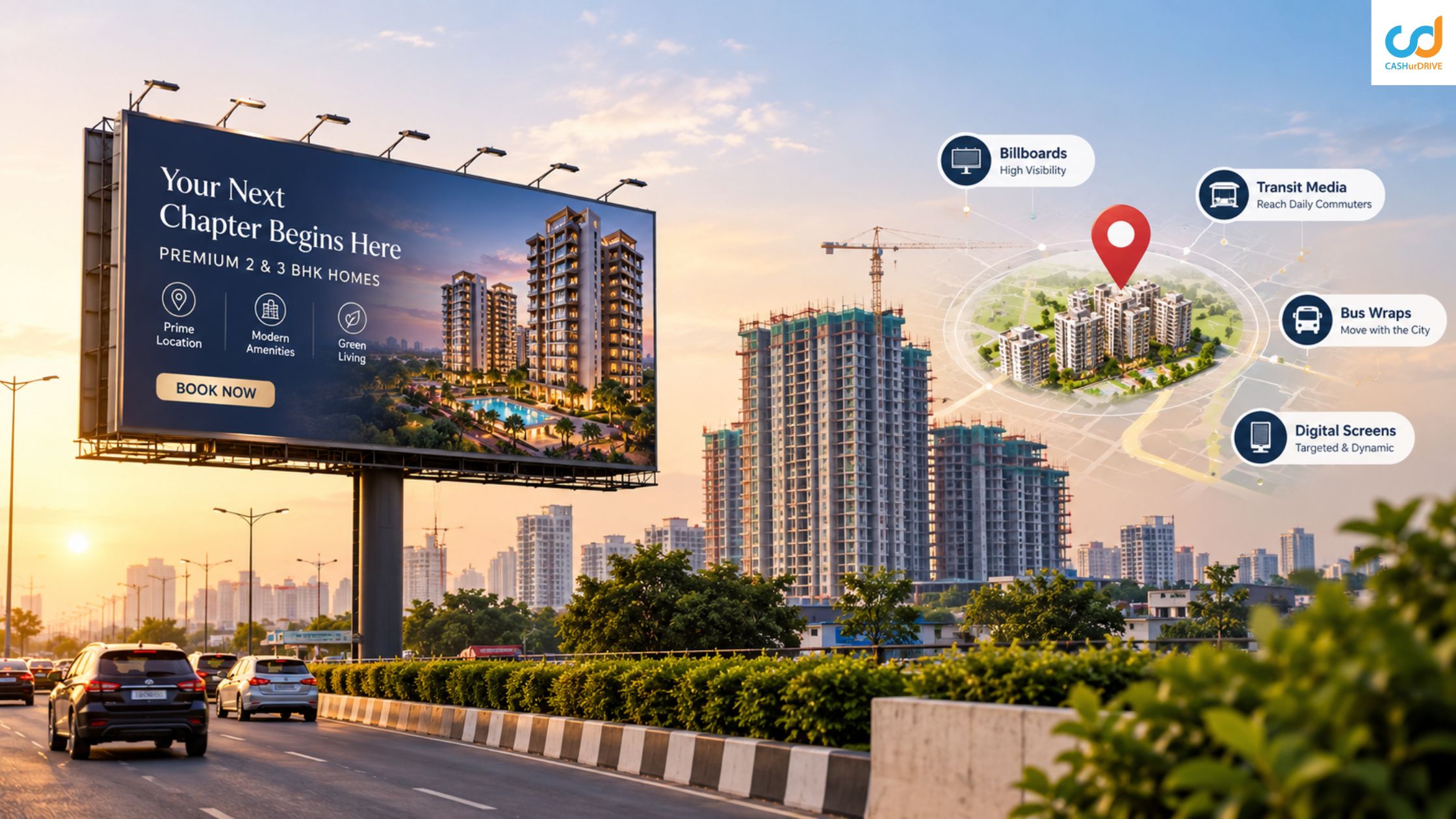
Real estate project launch advertising works across several OOH formats. Also, each format has a distinct role in the campaign. The choice depends on the project’s location, target buyer, and campaign goals.
Large-format hoardings and unipoles
A unipole within the site’s main road corridor anchors any launch campaign. For example, a 40×20 ft unipole on NH-48 in Gurugram delivers high daily reach. It runs on one of India’s busiest commuter roads. In Delhi NCR, unipole rates on main roads range from ₹2.5-5 lakh per month. Rates depend on location, facing, and lighting. These sites carry the project’s look and feel at scale. They are the format buyers recall when they walk into the sales office.
Transit media for city-wide reach
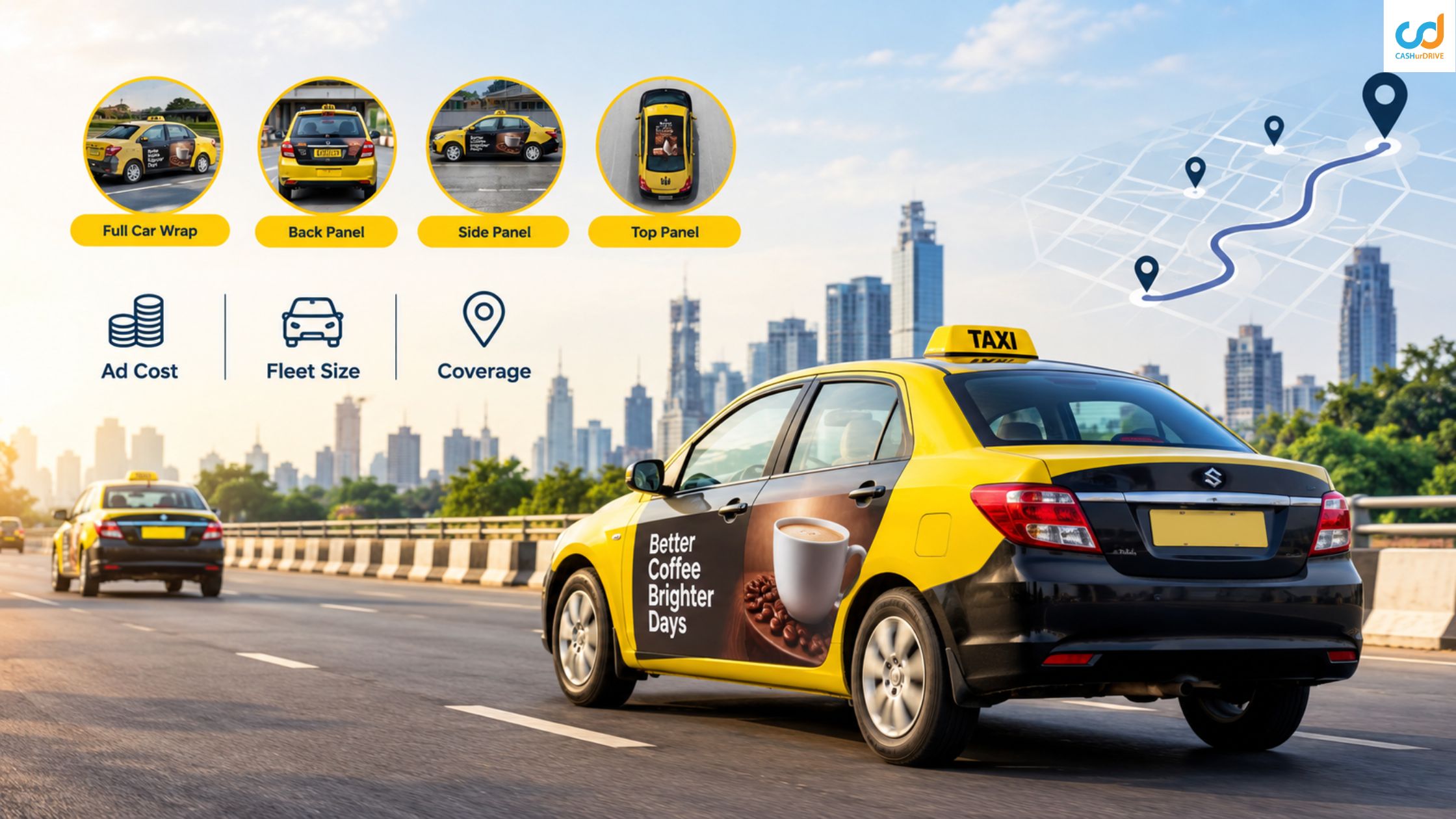
Also, a project launch must reach buyers who live outside the site radius. Transit media extends the campaign into buyer zones across the city. For example, a Noida project can run cab ads through Saket and Vasant Kunj. Unlike a fixed hoarding, a cab wrap reaches a new spot on each journey. CashUrDrive’s transit media formats cover cab, bus, auto-rickshaw, and metro. These run across Delhi NCR, Mumbai, and Bengaluru.
DOOH screens at high-value touchpoints
Also, DOOH screens at premium metro stations, malls, and airports reach high-NCCS buyers. These are places target buyers already visit. For a premium launch, a DOOH burst two weeks before possession day adds frequency. It hits at the right moment in the sales cycle. In addition, DOOH allows creative rotation. Different unit types or price points can run on the same screen network. Also, this format works for NRI investors at Tier 1 airport lounges.
Wall painting for hyperlocal saturation
Also, wall painting delivers brand presence at the local level. For real estate launches in Tier 2 cities, wall painting creates local cover. This applies in markets like Bhiwadi, Navi Mumbai, and Whitefield. Placements within 500 m keep the brand visible through the sales cycle. Unlike hoardings, wall painting sites are often long-duration. CashUrDrive’s digital wall painting format combines print quality with targeted placement.
Location Strategy: Placing OOH Media Around a New Development
[IMAGE: Map graphic showing concentric zones around a development site: 500m (hyperlocal), 2km (site proximity), 5km (buyer catchment), city-wide transit corridors]
In real estate project launch advertising, location is the most important variable. For example, the right OOH site reaches buyers near the project or on their commute. The wrong site delivers ads to people who will never visit the project.
Zone 1 – Site proximity (0-2 km)
Every real estate launch campaign needs at least two large-format sites within 2 km. In particular, these sites serve a directional role. They reach buyers already in the area and turn awareness into a site visit. For example, a hoarding at the turning toward the project is the last visible touchpoint.
Zone 2 – Buyer catchment corridors (2-10 km)
Home buyers typically live 5-10 km from a new project they consider. For a project in Gurgaon Sector 65, the buyer area includes South Delhi and Dwarka. Transit media on those corridors reaches buyers in their home zones. In practice, sales data from past phases often reveals two or three key corridors. Those corridors are where OOH spend goes first.
Zone 3 – Investor and broker touchpoints
Commercial and premium home launches also need OOH at investor touchpoints. These include airport terminals, hotel corridors, and premium mall spaces. These are not high-impression sites. However, they reach a narrow, high-net-worth audience at key decision moments. DOOH at these locations works without needing high media volume.
How Atlas changes location planning
Also, CashUrDrive’s Atlas platform maps where a project’s target buyer moves. It uses device-level geofencing and RWI scoring to do this. For example, a premium project targeting NCCS A buyers aged 35-50 can use Atlas. Atlas finds which OOH sites carry the highest density of that audience. The data is verified by real movement signals, not census estimates. As a result, fewer sites are booked on guesswork. More spend goes to sites with verified audience density.
▶ Request a free Atlas audience map for your real estate launch campaign – identify buyer corridors before booking OOH sites
How to Build a Real Estate OOH Campaign Budget
In short, a real estate launch campaign budget covers three phases. The first is pre-launch awareness. The second is launch activation. The third is sustained presence through the sales cycle. Also, the format and site mix changes across each phase.
| Phase / Variable | Example scenario – mid-ticket residential launch, Delhi NCR |
| Pre-launch (weeks 10-5) | Transit media – 150 cabs on buyer catchment routes: ~₹12,00,000 for 6 weeks |
| Launch activation (weeks 4-1) | 2 unipoles near site + DOOH burst at 3 premium locations: ~₹8,00,000 for 4 weeks |
| Sales cycle (weeks 1-8 post-launch) | 1 anchor hoarding near site entry + wall painting in project micro-market: ~₹5,00,000 for 8 weeks |
| Production (one-time) | Hoarding print + cab wrap install + DOOH creative: ~₹2,50,000 |
| Total indicative spend | ~₹27,50,000 across 14 weeks (indicative, 2026 rates) |
These are sample figures for a mid-ticket home launch in Delhi NCR. Affordable launches in Tier 2 markets like Jaipur run at lower rates. For instance, premium office launches in BKC carry higher costs. However, the phased structure stays the same in both cases. Transit runs first for city-wide reach. Large-format follows for site proximity. Then, sustained presence carries visibility through the sales cycle.
In contrast, a digital campaign at the same spend delivers a higher impression count. But it delivers lower audience confidence. In other words, Instagram reaches more people. However, no tool confirms those people are within 5 km of the site. No tool checks if they earn enough to buy the project. OOH combined with Atlas audience data bridges that gap.
▶ Get a real estate project launch advertising media plan with Atlas audience route analysis – /transit-advertising
Audience Intelligence and Real Estate OOH Planning
[IMAGE: Atlas dashboard screenshot concept showing audience density heatmap for a Delhi NCR corridor, with NCCS A/B segment markers]
Also, traditional OOH site selection starts with traffic, visibility, and cost. These are useful inputs. However, they do not answer the key question. Does this site reach the buyers this project is built for?
Atlas addresses this by layering data over site selection. For example, a developer selling a ₹1.2 crore flat in Noida needs NCCS A buyers. Specifically, these are dual-income couples aged 32-45 in Noida’s IT belt. Atlas maps their actual movement. It finds which OOH sites on those routes have the highest target buyer density. A hoarding on Expressway may appear to offer broad reach. However, if Atlas shows the target skews toward Sector 50-62, the plan shifts.
This pre-campaign check changes the economics of real estate OOH. A verified 200-cab campaign on buyer-dense corridors reliably outperforms 400 cabs on open network. Also, in real estate, a single site visit can be worth ₹1 crore or more. As a result, reach without targeting wastes the most expensive part of the campaign.
Also, Atlas tracks footfall back to the project site. It finds buyers who saw the OOH campaign. This gives developers proof that outdoor media drove site visits. Site visits are the metric that matters most.
Frequently Asked Questions
What is the best OOH format for real estate project launch advertising in India?
Real estate project launch advertising works best with a mix of formats. For example, large-format hoardings near the site anchor site-proximity visibility. Also, transit media on buyer corridors extends reach into the city. In addition, DOOH adds frequency at high-value spots. For example, a unipole within 1 km reaches buyers already nearby. Cab ads on routes from nearby home areas reach buyers where they live. The right format mix depends on the project’s location, ticket size, and target buyer.
How far from the project site should OOH media be placed?
Typically, real estate project launch advertising spans three zones. The first is 0-2 km from the site, for large-format hoardings. The second is 2-10 km, for transit media on buyer corridors. Finally, the third covers investor touchpoints – premium metro stations, malls, or airports. Atlas audience data helps find which corridors have the highest target buyer density.
How much does real estate OOH advertising cost in India?
Generally, real estate project launch advertising costs vary by city, format, and duration. In Delhi NCR, a unipole on a main road costs ₹2.5-5 lakh per month. Also, cab advertising runs at ₹8,000-14,000 per vehicle per month. A DOOH burst at a premium mall or metro station costs ₹1-3 lakh per week. As a result, a focused 14-week Delhi NCR launch runs ₹20-30 lakh in media spend. Tier 2 city campaigns are much lower.
How long should a real estate project launch advertising campaign run?
Overall, real estate project launch advertising works best across 10-14 weeks. The pre-launch phase – weeks 10 to 5 – uses transit media to build awareness. Then, the activation phase adds hoardings and a DOOH burst in weeks 4 through launch. Post-launch, a lighter presence keeps the brand visible through the sales cycle. In practice, campaigns that drop OOH after the launch week lose momentum. That is when site visits turn into bookings.
Can OOH advertising for a real estate launch be audience-targeted?
Audience-targeted OOH for real estate is available through CashUrDrive’s Atlas. Specifically, Atlas uses device-level geofencing and RWI scoring. It finds which OOH sites carry the highest density of target buyers. Also, the data is verified by real movement signals, not traffic counts. For example, a premium home launch can target NCCS A buyers on specific corridors. This happens before booking the fleet or hoarding sites. As a result, speculative site selection is replaced with verified data.
How is OOH different from digital advertising for real estate launches?
Digital ads reach buyers who are already in-market – people searching property portals. In contrast, real estate project launch advertising on OOH creates intent before the search begins. Also, OOH is anchored to a physical location. A hoarding near the site reaches the local area, not a broad interest group. According to Talon OOH’s 2026 report, 58% of consumers trust outdoor ads. For high-ticket purchases like property, that trust signal is hard to match digitally.
Conclusion
In conclusion, real estate project launch advertising works when three things align. The first is the right formats for the buyer profile. The second is sites chosen around verified audience corridors. Finally, the third is a campaign that covers the full buyer journey. In practice, the best OOH campaigns plan sites before booking them. Atlas audience data makes that possible. It turns a guesswork exercise into a verified plan. Specifically, it shows where target buyers move before the media plan is written.
▶ Get a real estate launch OOH media plan with Atlas audience map for your city
Author
CashUrDrive Editorial Team
CashUrDrive Marketing Limited – OOH and Transit Media Specialists
AI Disclosure: This article was produced with AI assistance and reviewed by the CashUrDrive editorial team.