Launching a Real Estate Project? How to Choose OOH Locations That Reach Potential Buyers
 By Annu
A launch hoarding goes up outside the site gate. It looks right in the presentation. However, many of the people who drive past it every day already live nearby, and some of them may never buy there. Meanwhile, the buyers who could fill the project may live or work across the city. That gap is where real estate project launch advertising can lose much of its value. This guide shows how to choose outdoor locations around where buyers come from, how they travel and how they reach your site office.
Why a project launch needs its own location plan
A real estate launch is not a normal brand campaign, for three reasons. First, the launch window is fixed. Bookings, offers and site-office staffing all peak in the same weeks. Second, the purchase is large and the decision is slow, so buyers need repeated, credible exposure rather than one glimpse. Third, the step that matters most is the site visit. An enquiry is useful, but a visit is where many sales begin.
In addition, there is competition at close range. Several projects often launch in the same micro-market, sometimes on the same road. As a result, outdoor advertising for property launches has two jobs at once. It must reach likely buyers wherever they are, and it must guide them to your site rather than the one next door. That is why real estate project launch advertising needs its own location plan.
Before you place real estate OOH media, however, check the law. Under the Real Estate (Regulation and Development) Act, 2016, a promoter generally cannot advertise or market a project before registering it with the state RERA. That said, Section 3(2) exempts some projects from registration, such as small projects within set land-area or unit limits, so confirm your project’s status first. For a registered project, every advertisement must carry the Authority’s website address and the project registration number. That includes hoardings.
Start with where your buyers come from, not where the project is
Many plans start by drawing a 5–10 km circle around the site and booking sites inside it. It is simple. Even so, it is the wrong shape. A circle can include neighbourhoods that are unlikely to buy your product. At the same time, it misses the office cluster across the city where many of your buyers spend their day. In practice, buyer catchments follow roads, commute lines and income bands, not radii.
So, before choosing any site, map buyer origin. Fortunately, most developers already hold the data:
- CRM pincodes from past projects. Where did buyers of similar projects live or work?
- Channel-partner data. Which areas do your brokers’ best leads come from?
- Enquiry locations. Where are enquiries for this project coming from in the pre-launch phase?
- Office clusters within commute range. Where do people with the right income band work?
Then plot these points on a map. Usually, two or three clusters stand out. Those clusters, and the roads that join them to your site, then become the plan. In other words, real estate project launch advertising should follow your buyers, not your site address. The site’s own neighbourhood is only one part of it.
Four location zones for real estate project launch advertising
Once buyer origin is mapped, split the plan into four zones. Because each zone has a different job, each needs different formats and checks.
1. Source catchments
These are the areas where likely buyers live and work. The job here, therefore, is awareness and credibility. Large formats near office clusters and premium residential pockets can build recognition before buyers ever see the site.
2. Commuter corridors
These are the daily routes between source catchments and the growth area. Here, repetition matters most. Commuters who use the same route both ways may see the message on the way to work and again on the way home, which suits a long decision cycle.
3. Approach roads
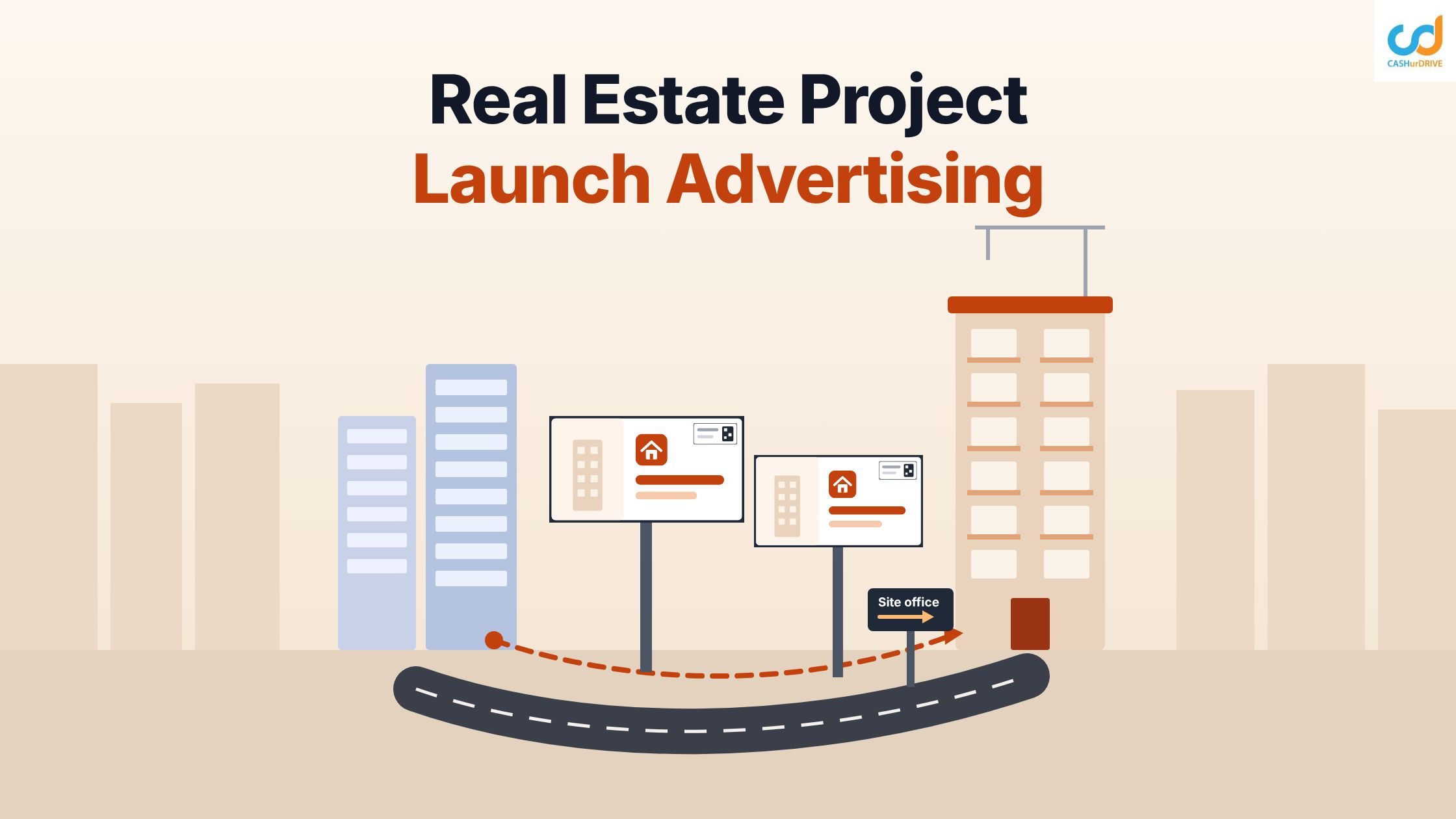
These are the last few kilometres to the site office. This zone therefore works as a sales tool, not branding. Clear direction and reassurance, such as “Site office 2 km ahead”, help a planned visit actually happen. Even so, many plans skip this zone, because it is less glamorous than a city-centre hoarding.
4. The site and its immediate area
The construction hoarding, entrance branding and sample-flat signage confirm that the visitor has arrived. They matter. However, they mostly reach people already nearby.
| Zone | Main job | Formats often considered | Check before booking |
| Source catchments | Awareness and credibility | Hoardings, unipoles, DOOH, mall media | Audience fit, clutter, competing projects |
| Commuter corridors | Repetition on daily routes | Unipoles, bus shelters, metro media, cab or bus branding | Direction of travel, frequency, route coverage |
| Approach roads | Direction and reassurance | Smaller hoardings, gantries, directional signage | Visibility on the approach, permissions |
| Site and surroundings | Arrival and trust | Site hoarding, entrance branding | RERA details, lighting, upkeep |
Still, treat this table as starting points. The right format depends on the city, the route, available inventory and your audience. For a wider view, see how the main outdoor advertising formats differ.
Phasing the launch: tease, launch, sustain
Location is only half of real estate project launch advertising. The other half is timing. A property launch campaign usually moves through three phases. Phase lengths vary by project, so set them to your own plan.
Tease. First, start in source catchments and on commuter corridors. The message builds curiosity about the location, the developer or the lifestyle. Project advertisements must follow your state RERA’s rules, and how a teaser is treated can vary, so confirm its disclosure requirements with the relevant authority before it runs. Meanwhile, digital can run search ads and lead forms aimed at the same catchments.
Launch. Next, concentrate. Add frequency on corridors and switch on the approach roads. Then the message becomes concrete: configuration, launch offer and directions to the site office. At the same time, retargeting and search can capture the interest the outdoor campaign helps create.
Sustain. Finally, reduce coverage to the corridors and approach roads that keep showing up in your site-visit data. Shift the message to construction progress, possession timelines or amenities.
In each phase, outdoor and digital play different roles. Outdoor builds familiarity and trust in the right places. Digital, in turn, can convert that interest into enquiries and site visits. Neither replaces the other.
Hypothetical: re-planning a 400-unit launch
HYPOTHETICAL AND ILLUSTRATIVE. A developer is launching a 400-unit project on a city’s outer growth corridor. Pre-launch enquiries show that buyers are concentrated in an IT cluster about 15 km away.
At first, the draft plan put most of the outdoor budget around the site. For illustration, say 60% near the site, 30% on approach roads and 10% elsewhere.
By contrast, the buyer-led plan reverses the weighting. Again for illustration only: 40% in and around the IT cluster, 35% on the corridor between it and the site, 20% on approach roads and 5% at the site. The site still gets its hoarding, but the money follows the buyers.
Note that these shares are not a recommendation. They only show how a buyer-origin map changes where real estate project launch advertising is placed. Your own split should come from your data and the inventory available on those routes.
A site-by-site checklist before you approve the plan
Before approving any site, first check it in person or with recent photos. A guide to verifying an outdoor advertising site covers the basics. For real estate project launch advertising, also check:
- Visibility on the actual approach. Can drivers heading towards your site see it, or only traffic going the other way?
- Clutter. How many other hoardings compete for the same view?
- Competing projects. Is a rival project advertising nearby? OOH specialist OSMO has also pointed to high-impact, clutter-free placements and minimising adjacency with competing projects.
- Night visibility. Is the site lit well enough for evening commuters?
- Permissions. Does the site have the required local approvals?
- RERA details. Are the registration number and Authority website readable from viewing distance? Several states add their own rules on placement, font size or QR codes. For example, Gujarat RERA fined a promoter ₹60,000 because a project-site hoarding lacked the RERA website address. Similarly, MahaRERA penalised a promoter whose RERA number and QR code were blurred in an advertisement. Therefore, check your state RERA’s advertisement order before printing.
How to read the results honestly
Launch numbers are noisy, because offers, brokers, digital ads and word of mouth all move the same enquiries. Still, a few signals help:
- Campaign-specific phone numbers or QR codes on outdoor creatives, kept separate from digital ones.
- A source question at the site office, asked at every visit.
- Broad branded-search trends in Google Search Console, and regional interest in Google Trends.
- Enquiry pincodes compared with the zones you bought.
However, treat any link between outdoor and bookings as a correlation, not proof. Instead, look for patterns across several signals rather than one number.
Plan your launch around your buyers
In short, strong real estate project launch advertising starts with a map of where your buyers live, work and travel. Then it fills source catchments, corridors and approach roads in the right order, with compliant creativity. If you are planning a launch, request an indicative media plan from CashUrDrive, with location and format recommendations built around your buyer data. You can also review outdoor advertising services and what an outdoor advertising campaign plan should include.
Frequently asked questions
Q1: How far from the project site should hoardings be?
There is no fixed distance. Base locations on buyer-origin data, the commuter corridors those buyers use, and the approach roads to your site office. Some sites may be 1 km from the project; others may be across the city.
Q2: How early should real estate project advertising start?
Work backwards from the launch date. If the project needs RERA registration, that must come first, because it cannot be advertised before registration. Then allow time for site booking, printing and installation. Lead times vary by city and format, so confirm them early.
Q3: Can digital advertising replace outdoor for a property launch?
Not on its own, because they do different jobs. Outdoor builds local familiarity and trust in the places buyers pass. Digital can capture and convert that interest. So plan them together.
Q4: What must a real estate hoarding show under RERA?
For a registered project, at minimum, the RERA registration number and the Authority’s website address. In addition, several states add rules on placement, size or QR codes, so check your state RERA’s order.