Diwali OOH Advertising Cost in India 2026: What You’ll Actually Pay
 By Annu
Ask three vendors for a Diwali OOH rate. You’ll get three different answers. None of them will be wrong. Diwali advertising cost in India is genuinely complicated. And the festive window pushes everything higher than it would normally be.
This guide puts actual numbers on the table – city by city, format by format. It also tells you what moves the rate up or down. So you can read a vendor quote and know whether it’s fair.
What Diwali OOH Actually Costs
Start with the practical range. Standard urban hoardings in Delhi and Mumbai normally run ₹50,000 to ₹3 lakh per month. During Diwali, add 50% to 100% on top of that.
So a site that costs ₹1 lakh in July may cost ₹1.5 lakh to ₹2 lakh in November. That’s the festive premium. It’s real, it’s consistent, and almost every operator applies it.
The specific number depends on the city, the site, and the format. The sections below break it down.
Diwali Hoarding Rates by City
The table below shows standard monthly hoarding rates and the estimated Diwali range. The festive premium is 1.5x to 2x the base rate in most markets. Sites near Diwali market zones sit at the top of each range.
|
Market |
Standard Monthly Rate | Estimated Diwali Range |
| Delhi – Premium (CP, South Extension, Noida Expressway) | ₹1.25L – ₹10L | ₹2L – ₹18L+ |
| Delhi – Standard city locations | ₹1L – ₹4L | ₹1.5L – ₹7L |
| Delhi – Secondary / residential | ₹20K – ₹80K | ₹30K – ₹1.5L |
| Mumbai – Premium (Marine Drive, Bandra-Worli, SCLR) | ₹3L – ₹12L | ₹5L – ₹20L+ |
| Mumbai — Standard city locations | ₹50K – ₹3L | ₹75K – ₹5L |
| Bengaluru — Premium (MG Road, Koramangala, Whitefield) | ₹80K – ₹7L | ₹1.2L – ₹12L |
| Tier 2 (Pune, Ahmedabad, Jaipur) | ₹20K – ₹1.5L | ₹30K – ₹2.5L |
Note: All pricing listed above represents estimated market approximations for reference purposes, as official rates require management review, seasonal festive adjustments, and city-specific vendor confirmations.
These are general market rates. Final quotes vary by specific location, vendor and when you book. But they give you a baseline to work from.
Delhi NCR
Delhi’s premium Diwali sites – Connaught Place, South Extension, Karol Bagh, Noida Expressway – are the most in-demand outdoor real estate in India during the festive season. Sites near Chandni Chowk and Sadar Bazaar face the most pressure. Brands in jewellery, electronics and FMCG are all competing for the same locations.
Secondary locations like residential arterials and suburb junctions remain accessible. These are often the right choice for brands targeting local catchments rather than city-wide reach.
Mumbai
Mumbai is the most expensive outdoor market in India. Premium sites are genuinely scarce during Diwali. For base rates and a full city breakdown, see the billboard advertising cost in India guide. For Diwali, Zaveri Bazaar and Crawford Market proximity sites are the hardest to get. Book in September.
Bengaluru and Other Metros
Bengaluru runs cheaper than Mumbai and Delhi. Hyderabad and Chennai are cheaper still. For national brands, Bengaluru and Hyderabad are often the right test markets before committing budget to Delhi or Mumbai.
Even so, the festive premium applies everywhere. A Bengaluru premium site at MG Road in November costs roughly 1.5x what it costs in June.
DOOH Rates During Diwali
DOOH advertising cost runs 1.5x to 2x the rate of a comparable static site – even before the festive premium. During Diwali, the two premiums stack.
| DOOH Location | Standard Monthly Rate | Estimated Diwali Range |
| Metro roads and premium junctions | ₹75K – ₹3.5L | ₹1.1L – ₹6L+ |
| Shopping malls | ₹40K – ₹2.5L | ₹60K – ₹4L |
| Railway stations | ₹60K – ₹4L | ₹90K – ₹6L |
| Tier 2 and 3 cities | ₹20K – ₹80K | ₹30K – ₹1.5L |
Note: All pricing listed above represents estimated market approximations for reference purposes, as official rates require management review, seasonal festive adjustments, and city-specific vendor confirmations.
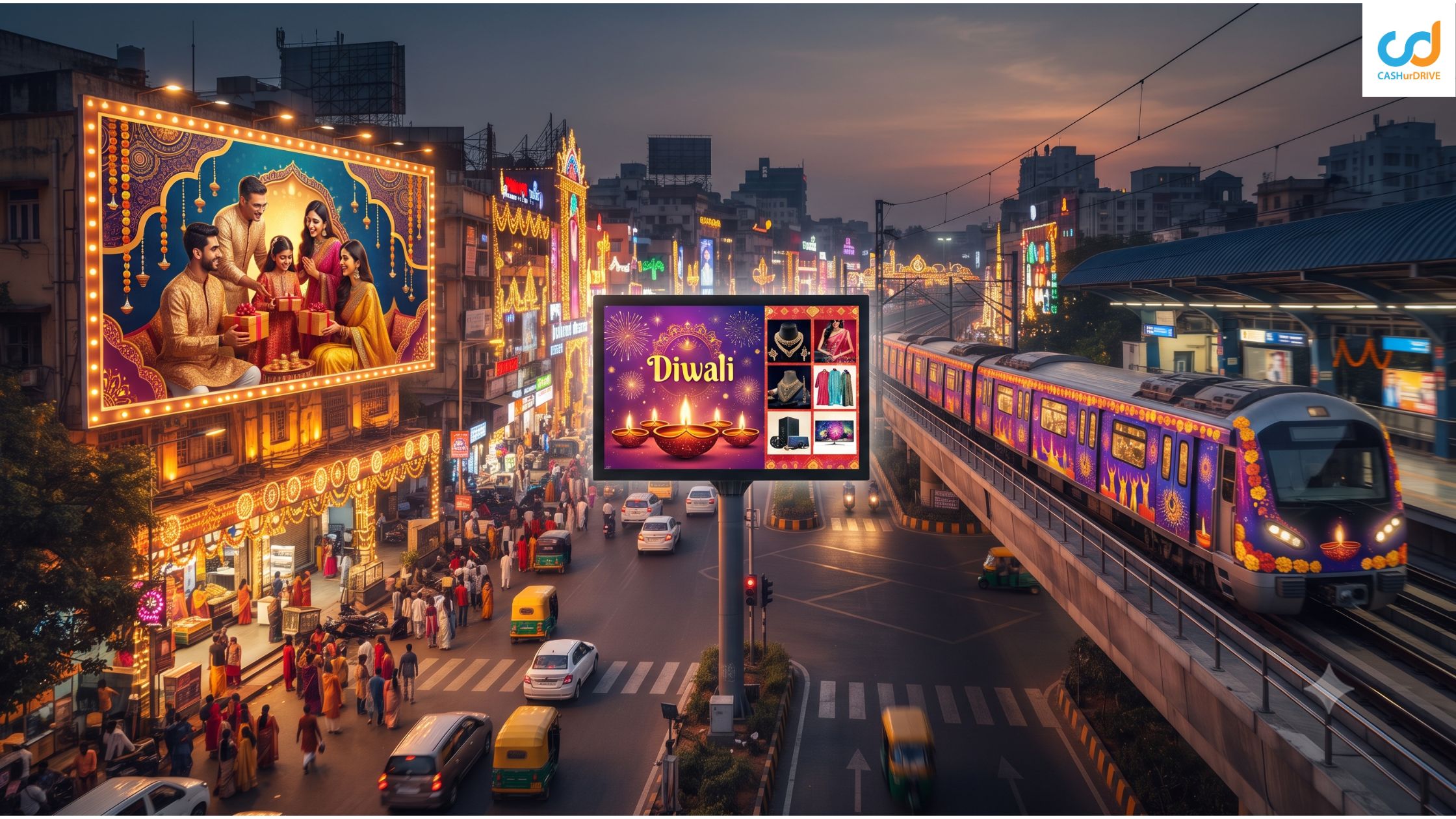
DOOH has one advantage that static doesn’t. You don’t pay to reprint. A brand can run a Dhanteras creative on 6 November and a main Diwali creative on 8 November at no extra cost. Multiple message changes over a five-day festival window? DOOH earns its premium on those campaigns.
Need a Diwali OOH rate for your format and city? Get an Indicative OOH Budget & Media Plan →
Transit Advertising at Diwali: Bus, Auto and Metro
Bus Branding
DTC bus branding in Delhi is priced per bus per month. Format makes the biggest difference:
| Format | Standard Rate / Bus / Month | Diwali Estimate |
| Rear panel | ₹6,000 – ₹12,000 | ₹9,000 – ₹18,000 |
| Side panel | ₹12,000 – ₹35,000 | ₹18,000 – ₹52,000 |
| Full wrap — non-AC bus | ₹19,000 – ₹30,000 | ₹28,000 – ₹45,000 |
| Full wrap — AC / premium bus | ₹50,000 – ₹2.25L | ₹75,000 – ₹3.5L |
Add ₹3,000 to ₹15,000 per bus for printing and installation. Fleet packages bring per-bus costs down. Ten buses with side panel branding comes to roughly ₹1.2 lakh to ₹3.5 lakh per month.
Note: The pricing mentioned above is based on industry estimates and online research as of 2026. Actual prices may vary depending on specific requirements, location, and service providers. Please check the official website for real-time rates.
Auto-Rickshaw Advertising
Auto-rickshaw advertising is priced per auto per campaign period. Rates depend on the city, the format and the operating zone. Zone selection matters a lot here. An auto fleet in the Lajpat Nagar permit zone serves a very different audience from one in an outer-ring zone. Contact CashUrDrive for zone-specific auto rates.
Metro Station Branding (DMRC)
DMRC metro advertising goes through a formal approval process. Rates are set by DMRC and depend on the station and format. Stations near Chandni Chowk, Rajiv Chowk and Lajpat Nagar are the most sought-after Diwali OOH in Delhi.
Start the DMRC approval process three months before the festival. That’s August for Diwali 2026. If you leave it until September, you risk losing the stations you want.
The Festive Premium – What’s Actually Driving It
Three things push Diwali OOH rates up.
First: demand. Every brand wants to advertise in October and November. But the number of good sites doesn’t change. Simple supply and demand.
Second: timing pressure. Premium sites fill 6 to 8 weeks before Diwali. Brands that book in October pay more for what’s left. Some find the sites they need are gone entirely.
Third: location-specific pressure. A site near Chandni Chowk in November faces a different kind of demand from a standard junction. Jewellery brands, electronics brands, fintech brands – all of them want that proximity. The rate reflects it.
The festive premium isn’t a scam. It’s what happens when too many brands want the same limited inventory at the same time of year.
Dhanteras: The Day With Its Own Pricing Logic
Dhanteras falls on 6 November 2026. It’s the single biggest purchase day for gold and electronics in India. More jewellery and electronics is sold on Dhanteras than on any other day of the year.
Sites near jewellery and electronics market zones see peak demand on this specific day. Some operators price Dhanteras separately. Most don’t. But it’s worth asking – especially if your brand sits in jewellery, electronics or fintech.
The practical advice: treat Dhanteras as a separate campaign decision. The audience on 6 November is different from the general Diwali shopper. A placement near Zaveri Bazaar or a Delhi electronics market on Dhanteras is worth planning – and budgeting – separately from the rest of the Diwali campaign.
Static Hoarding vs. DOOH at Diwali: Which Costs Less?
It depends on how often you change the creative. Here’s the honest comparison:
|
Format |
Static Vinyl |
Digital OOH (DOOH) |
| Media rate (standard) | Base rate | 1.5x – 2x static rate |
| Festive premium | Add 1.5x – 2x | Add 1.5x – 2x |
| Production per creative | ₹15K – ₹50K | No reprinting cost |
| Creative changes at Diwali | New print each time | Upload digitally — no extra cost |
| Best for | One message, 30+ days | Multi-day festive campaign |
| Total cost over 5 festival days | Lower if one creative | Lower if multiple creatives |
Static is cheaper if you’re running one message for the full Diwali window. DOOH earns its higher media rate when you want to change messaging across the five festival days.
A brand running different creatives for Dhanteras, main Diwali and Bhai Dooj would pay ₹75,000 to ₹2.5 lakh in static reprints alone. DOOH avoids that cost entirely. Over a full five-day campaign, DOOH often works out cheaper per message even with the higher screen rate.
What Makes a Diwali OOH Site Worth Paying More For
Not all premium sites deliver premium results. Here’s what actually justifies a higher rate.
Traffic count
Ask for the daily traffic count before agreeing to any rate. How many vehicles or people pass that site? A reputable vendor will have this data. One that doesn’t is a red flag. The rate is supposed to reflect footfall – you should be able to verify it.
Proximity to purchase
A site 100 metres from Chandni Chowk during Diwali isn’t just reaching any audience. It’s reaching people who are actively shopping for gifts. That’s different from the same audience at a standard junction. Proximity to purchase is worth paying for. A site three kilometres away from the market at a lower rate often delivers less even though it costs less.
Visibility quality
Is the board facing the right direction? Is it obstructed by a tree or another structure? A ₹3 lakh board facing the wrong way delivers less than a ₹1 lakh board that every commuter sees clearly. Always do a site visit or ask for a visibility photograph before confirming. Site selection is where most Diwali campaigns are won or lost before a creative is even printed.
For a full breakdown of OOH format options and how to plan across cities, see Diwali OOH advertising formats.
How to Build a Diwali OOH Budget
Start with five decisions:
- Format: Hoarding, DOOH, bus, auto or metro. Each has a different cost structure. The format choice should follow the campaign goal, not the other way around.
- City and zone: Delhi and Mumbai are the most expensive markets. Bengaluru and Hyderabad are mid-range. Tier 2 cities cost significantly less. Market zone proximity adds cost inside each city.
- Duration: Most Diwali campaigns run 10 to 30 days. Longer bookings usually get a lower monthly rate. A 90-day commitment can save 10 to 20% on the monthly rate.
- Festive premium: Apply 1.5x to 2x on top of standard rates. Sites near market zones sit at the higher end.
- Production: Static hoarding print: ₹15,000 to ₹50,000 per creative. Bus vinyl and install: ₹3,000 to ₹15,000 per unit. DOOH has no print cost.
↳ A practical starting point: 3 to 4 standard hoardings in Delhi or Mumbai, 30 days, media and production included – budget roughly ₹8 lakh to ₹10 lakh. Premium market zone sites or metro branding will push this significantly higher.
Frequently Asked Questions
Rates, Premiums and Formats
Q1. What does Diwali OOH advertising cost in India in 2026?
Standard urban hoardings normally run ₹50,000 to ₹3 lakh per month. During Diwali, add 1.5x to 2x on top of that. So budget ₹75,000 to ₹6 lakh per site depending on the city and tier. DOOH runs higher. Bus and auto advertising is priced per unit and is the most accessible entry point.
Q2. How much more expensive is Diwali versus a standard campaign?
Expect the festive premium to add 50% to 100% on base rates. Sites near Diwali market zones – Chandni Chowk, Zaveri Bazaar, Karol Bagh – sit at the top of that range. In addition, early booking before September avoids last-minute rate increases when inventory is scarce.
Q3. Does Dhanteras advertising cost more than regular Diwali advertising?
Some operators price Dhanteras specifically, especially near jewellery and electronics market zones. Most apply the general festive premium across the full window. It’s worth asking the vendor directly. For brands in jewellery, electronics or fintech, treat Dhanteras as a separate campaign decision entirely.
Budget, Booking and Timing
Q4. Which format gives the best value for a Diwali OOH campaign?
Bus rear panels are the most cost-accessible transit format. Standard hoardings on city arterials offer solid value at ₹50,000 to ₹2 lakh per month. DOOH costs more per screen but saves on reprinting. For a Diwali campaign with multiple message changes, DOOH often works out cheaper per message over five days. Metro branding delivers a premium captive audience but carries the highest rates.
Q5. How early should a Diwali OOH budget be confirmed?
By early September at the latest for most formats. Metro branding (DMRC) needs three months – so August for Diwali 2026. Premium market zone sites in Delhi and Mumbai fill up 6 to 8 weeks before the festival. The earlier you confirm, the more choice you have and the better the rate you’ll get.
The Bottom Line
Diwali OOH is expensive because it works. Brands that invest in it correctly – right format, right city, right zone, early booking – reach an audience that is actively spending. That’s rare in any advertising medium.
The festive premium is real. The inventory pressure is real. But neither is a reason to avoid OOH in November. They’re reasons to plan earlier.
Get an Indicative OOH Budget & Media Plan
Author: CashUrDrive Editorial Team
This article was produced with AI assistance and reviewed by the CashUrDrive editorial team