Metro Advertising Cost in India 2026: Station, Train & Screen Rates
 By Annu
Metro advertising cost in India varies by city, format and station. However, a mid-tier pillar wrap starts from around ₹50,000 per month. In contrast, a full Rajiv Chowk domination can run ₹25 lakh or more. So understanding where you sit in that range matters. It is the first step in any metro media plan.
Specifically, this guide covers metro advertising cost by format, station tier and city. In fact, all figures here are indicative planning ranges for 2026. They are not fixed rate cards. In fact, final costs depend on the metro network, station tier and format size. So use these numbers to build a starting budget. Then confirm current rates with the metro media operator before booking.
Why Metro Advertising Commands a Price Premium
Metro advertising costs more than most transit formats. Three reasons explain this.
First, captive reach. In fact, metro riders are in a closed environment for up to 90 minutes. Also, they cannot skip the advertising or change the channel. Also, many are standing or waiting, which increases dwell time.
Second, audience quality. Delhi Metro alone carries over 5.5 million daily riders. Also, the metro audience skews towards SEC A and B consumers. In fact, tech workers, corporate employees and mid-income earners make up the core metro audience. In fact, these are exactly the groups most brands want to reach.
Third, limited inventory. Also, each station has a fixed number of ad spots. So, premium positions at hub stations are in high demand. In fact, popular formats at high-footfall stations book out weeks in advance. In fact, metro advertising cost in India reflects supply pressure, not just audience size.
Metro Advertising Formats and Inventory Types
Specifically, metro advertising covers a wide range of formats. Also, each format sits at a different point in the commuter journey. Consequently, similar-sized formats at the same station can have very different rates.
Station domination: Full or partial station branding using pillar wraps.
Pillar wraps: Vinyl wraps on platform and concourse pillars. In fact, these are the most common entry-level formats. Also, they offer high dwell time as passengers wait on the platform.
Gantry hoardings: Large-format structures above the concourse or across platforms. Specifically, these are the closest metro equivalent to a roadside hoarding.
Digital screens (DOOH): LED and LCD screens at concourse level.
Train interior panels: Panel advertisements inside metro coaches, above seats and near doors. Specifically, these deliver 20 to 40 minutes of captive exposure per commute leg.
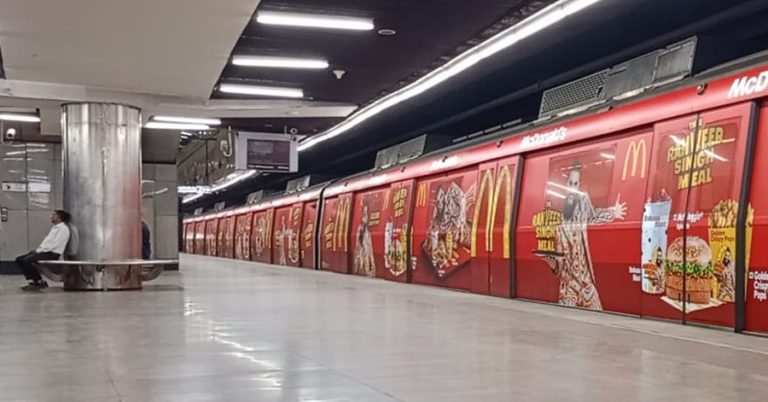
Train exterior (full wrap): Brand messaging on the exterior of metro coaches. Consequently, these are visible to station crowds, approach traffic and other commuters.
Platform screen doors: Branding on the glass panels of the automated platform doors. Also, these are visible at close range while passengers wait to board.
Escalator and lift panels: Panels along escalator runs and near elevator entrances. Also, these reach commuters during the 30 to 60 seconds of transition time.
Fare gate surrounds: Branding on and around the automatic fare collection gates. Specifically, every commuter passes through these on entry and exit.
For a full breakdown of how each format performs as part of a campaign, see the metro advertising campaign guide.
Indicative Costs by Format: 2026 Rates
All rates below are indicative planning ranges only. They are not fixed rate cards. Actual cost varies by network, station tier, footfall, format and operator. Always confirm current rates with the metro media partner before booking.
Specifically, metro advertising cost in India varies most by station tier. The figures below reflect Tier 1 inventory in Delhi and Mumbai. Rates at mid-tier stations and secondary cities will be lower.
|
Format |
Indicative planning range (per month) | Notes |
|
Full station domination |
₹8L-₹25L+ | Includes pillars, panels, screens and concourse |
|
Gantry hoarding (large) |
₹3L-₹12L |
Size and position drive rate variation |
|
Digital screen – concourse DOOH |
₹1.5L-₹8L |
High-traffic concourse positions command premium |
| Digital screen – platform DOOH | ₹75K-₹4L |
Platform screens offer very high dwell time |
|
Pillar wrap (per pillar) |
₹50K-₹2.5L |
Platform pillars vs concourse pillars vary significantly |
|
Train interior panel |
₹50K-₹3L | Per coach set; duration and line affect rate |
| Train exterior wrap | ₹8L-₹25L+ |
Full or partial wrap; coach count varies |
|
Platform screen door branding |
₹75K-₹3L | Per station; limited inventory at most stations |
| Escalator and lift panels | ₹30K-₹1.5L |
Lower rates, high transition frequency |
| Fare gate surrounds | ₹40K-₹2L |
Every commuter contact point |
Production costs run from ₹15,000 to ₹1 lakh+ per creative. This depends on the format and material. However, digital formats remove print costs but require content production and upload fees.
Need metro advertising cost estimates for a specific station or line? Get an Indicative Metro Advertising Cost and Media Plan →
Metro Advertising Cost by City
However, metro advertising cost in India varies by city and network. Delhi and Mumbai command the highest rates. However, Bengaluru, Hyderabad and Chennai offer strong audience quality at lower cost.
Delhi Metro (DMRC)
Delhi Metro is India’s largest and most-advertised metro network. It has 254 stations across 8 lines, serving over 5.5 million daily riders. In fact, Rajiv Chowk and Kashmere Gate are the top positions in DMRC. These are interchange stations with the highest daily footfall.
Indicative range for premium Delhi Metro positions: ₹8L to ₹25L+ per month. Mid-tier stations run from ₹1L to ₹8L per month.
Mumbai Metro
Mumbai Metro is expanding rapidly. Line 1 (Versova-Andheri-Ghatkopar), Line 2A (Dahisar-D.N. Nagar) and Line 7 (Andheri-Dahisar) now cover key commuter corridors. Specifically, the Andheri interchange and airport-adjacent stations carry the highest traffic.
Indicative range for premium Mumbai Metro positions: ₹3L to ₹15L per month. Mid-tier stations run from ₹75K to ₹3L per month.
Bengaluru (Namma Metro)
Bengaluru’s Namma Metro covers the Purple and Green lines. Also, Phase 2 expansion has added strong new ridership. In Bengaluru, the metro audience skews towards the technology sector and corporate professionals.
Indicative range: ₹1L to ₹10L per month for premium formats.
Hyderabad (L&T Metro Rail)
Hyderabad Metro is one of the longest elevated metro systems in the world. Specifically, it covers three corridors and 57 stations. Also, the Ameerpet interchange and airport corridor attract the highest demand.
Indicative range: ₹75K to ₹8L per month for premium formats.
Chennai Metro
Chennai Metro has two operational lines. Also, Phase 2 expansion is under way. Indicative range: ₹50K to ₹6L per month.
For a broader look at metro formats as part of a transit strategy, see metro train advertising.
Delhi Metro Advertising Cost: Stations and Lines
Delhi Metro advertising cost varies widely by station tier. Specifically, DMRC classifies stations into tiers based on daily footfall. Specifically, interchange stations carry a premium of 1.5x to 3x over mid-tier stations.
|
Station tier |
Examples | Indicative premium over base rate |
|
Interchange / Tier 1 |
Rajiv Chowk, Kashmere Gate, New Delhi, Central Secretariat |
2x-3x base rate |
|
High-footfall / Tier 2 |
Hauz Khas, Dwarka Sec 21, Noida City Centre, Botanical Garden |
1.5x base rate |
|
Standard / Tier 3 |
Mid-line stations on Blue, Yellow, Red Lines |
Base rate |
| Terminal / lower footfall | End-of-line stations on all lines |
0.7x-0.9x base rate |
In fact, Yellow and Blue Line stations command the highest rates. These two lines carry the bulk of Delhi Metro ridership.
Also, Pink Line (Majlis Park-Shiv Vihar) stations have grown significantly in advertising value. However, Tier 1 station bookings need 10 to 12 weeks minimum.
What’s in the Quote and What Isn’t
In fact, metro advertising cost in India comes at different price levels. Metro advertising quotes from operators often cover only the media rental. However, several additional costs add up quickly.
What’s usually included
- Media rental for the agreed period
- Basic proof-of-display and campaign reports
What’s usually NOT included
- Creative design and artwork production fees
- Print and material for static formats (₹15K-75K per creative)
- Digital content production and screen upload fees
- Installation, removal and surface restoration
- GST at 18% on the media rental
- DMRC or operator approval costs for brand and artwork clearance
Approval fees are the most missed cost in metro advertising budgets. DMRC requires brand approval before booking. Factor in 3 to 4 weeks for this process.
For a broader look at transit media formats and how to compare costs across channels, see transit media advertising.
How Metro Advertising Rates Are Set
Metro advertising rates are set differently from roadside OOH. Specifically, several factors drive metro advertising cost in India.
Station footfall tier: DMRC and other operators classify stations by daily ridership. Specifically, Tier 1 hub stations carry a 2x to 3x premium.
Format type and visibility: Large-format gantry hoardings and station domination command a premium. However, escalator panels and fare gate surrounds offer a lower entry point.
Line and corridor: Yellow and Blue line stations in Delhi carry the highest rates. Specifically, these lines serve the highest-footfall corridors in the network.
Booking duration: Also, longer campaigns (3 to 6 months) may attract better rates. However, short bookings at premium stations are hard to get at any discount.
Operator exclusivity: Metro media is sold through agencies. In Delhi, Times OOH and other agencies manage DMRC inventory. So, direct talks with DMRC are not possible.
Seasonal demand: Festive periods and election seasons drive up rates at key stations. Specifically, book 10 to 12 weeks ahead for Diwali and Q4 campaigns.
For a full view of how metro advertising fits into an OOH media strategy, see OOH advertising.
Frequently Asked Questions
Costs and Formats
Q1: How much does metro advertising cost in India?
Metro advertising cost in India starts from around ₹30,000 per month. At the top end, Tier 1 station domination runs ₹25 lakh or more. Specifically, Delhi Metro Tier 1 stations command the highest rates. However, these are indicative planning figures. In fact, actual costs depend on the network and station tier. Actual costs depend on the network, station tier, format and booking length.
Q2: What is the most expensive metro station for advertising in Delhi?
Specifically, Rajiv Chowk sets the highest metro advertising cost in India benchmark. It sits at the Yellow and Blue line interchange. In fact, it has the highest daily volume in Delhi Metro. Also, full domination at Rajiv Chowk can run ₹20 lakh to ₹25 lakh. In fact, Kashmere Gate, the Red-Yellow-Violet line interchange, is the second-highest value station.
Q3: Which metro advertising format gives the best return?
In fact, train interior panels deliver the highest dwell time. They also justify a higher metro advertising cost per booking. Specifically, a commuter sits with the same brand for up to 40 minutes. Also, platform pillar wraps balance footfall reach and dwell time at lower cost. However, the best format depends on the campaign goal and target audience.
Booking and Planning
Q4: How far in advance should brands book metro advertising?
In fact, Tier 1 Delhi Metro stations require 10 to 12 weeks. In fact, this covers DMRC brand approval (3 to 4 weeks), booking sign-off and artwork time. So begin cost planning at least 3 months before the launch date. Also, confirm whether DMRC approval needs fresh submission.
Q5: Does GST apply to metro advertising?
Yes. In fact, GST at 18% applies to all metro advertising cost in India. However, most quotes from operators show only the base media cost. So always clarify whether the rate shown includes or excludes GST. Also ask about DMRC costs, production and install before finalising.
Q6: Can small brands advertise on the metro?
Yes. In fact, entry-level metro advertising cost is accessible for smaller brands. Entry-level formats start from around ₹30,000 per month. Escalator panels and pillar wraps at mid-tier stations are the main options. These let smaller brands test metro media without a full station domination budget. Also, mid-line Yellow and Blue line stations offer footfall at Tier 2 rates.
Metro Advertising Cost in India: Station Tier Comes First
However, metro advertising cost in India is not one fixed number. In fact, metro advertising cost for the same format can vary 3x across stations. Specifically, the most important planning decision is station selection, not format selection.
Specifically, start with the audience: which stations do your target riders pass through? In fact, metro advertising cost in India is lowest when you pick the right station first. Then match the format to the budget and the objective. Consequently, a good pillar wrap at the right station beats the wrong gantry.
In summary, use metro advertising for audience quality, dwell time and urban reach. However, always get the station tier right first. Everything else follows from that.
Get an Indicative Metro Advertising Cost and Media Plan
Author: CashUrDrive Editorial Team
This article was produced with AI assistance and reviewed by the CashUrDrive editorial team.