Auto-Rickshaw Advertising in India: Costs, Routes and Formats (2026 Guide)
 By Annu
Billboards reach the main road. Buses cover the big routes. But the lanes your audience actually lives in – the residential colony, the local market, the street next to the school – that’s where auto-rickshaw advertising goes. With 8 million+ registered three-wheelers moving through every corner of urban India, auto advertising puts your brand exactly where no other transit format can follow.
What Is Auto-Rickshaw Advertising?
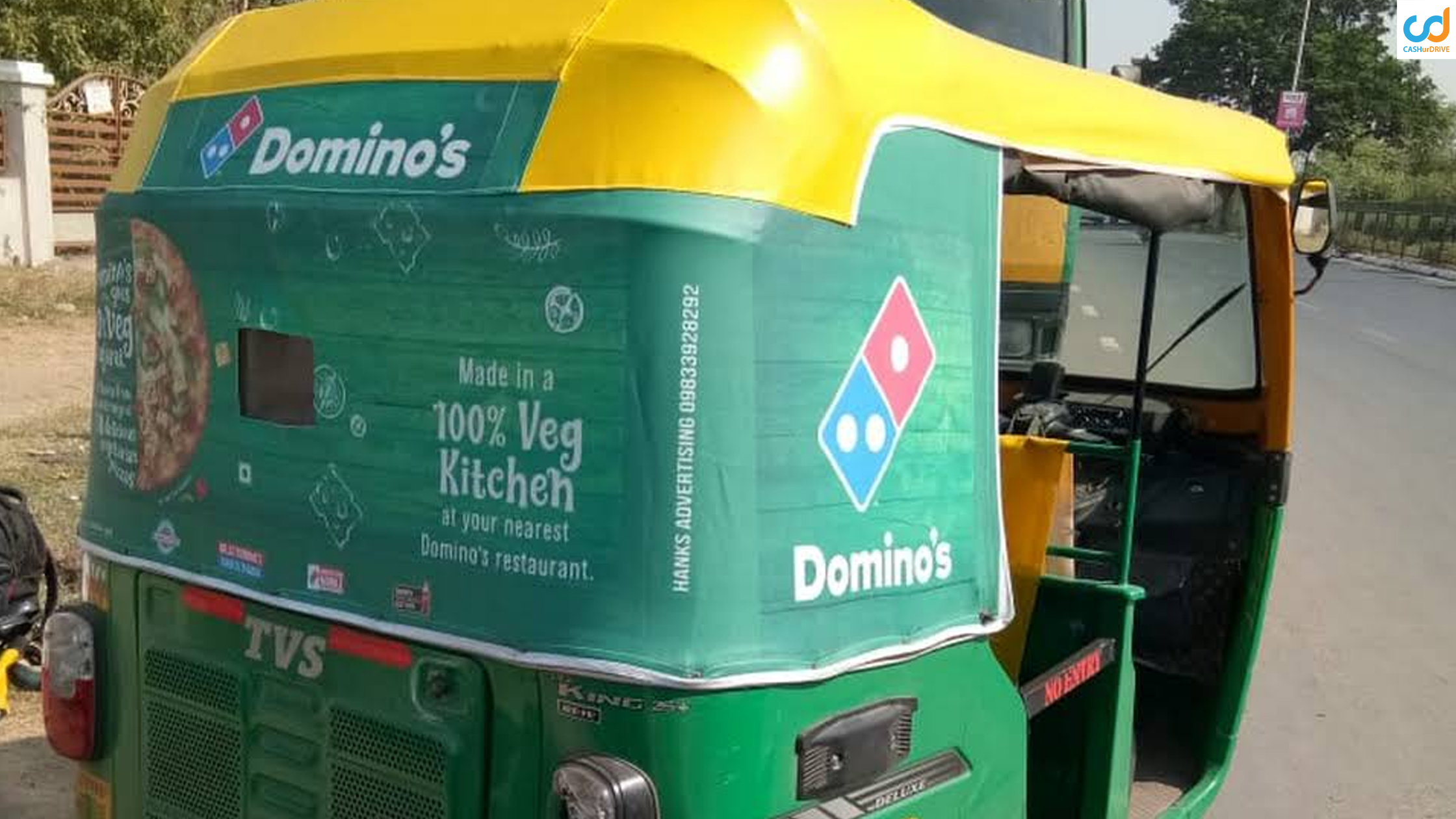
Auto-rickshaw advertising is a transit media format that wraps brand messages on auto-rickshaws, reaching hyperlocal urban audiences across India’s 8 million+ registered three-wheelers. A single branded auto generates high-frequency impressions on the routes it travels daily – penetrating residential lanes and local markets that no other OOH format can enter.
Here’s why it stands apart from every other OOH format.
A billboard stands still. A bus follows a fixed route through major roads. An auto-rickshaw goes everywhere – the gully behind the shopping complex, the colony lane, the route between the metro station and the local market.
That last-mile reach is what makes auto advertising irreplaceable for hyperlocal campaigns.
India has over 8 million registered auto-rickshaws. They operate across every major city and most Tier 2 towns. At an average of 8–12 trips per day, a single branded auto covers the same catchment zone repeatedly — building the frequency that creates brand recall.
Why Does Auto-Rickshaw Advertising Work So Well in Indian Cities?
- It goes where other formats physically cannot: Hoardings need wall space. Buses need wide roads. Autos fit everywhere. Residential lanes, local market alleys, school drop-off zones, hospital catchments, college roads – auto advertising reaches these micro-catchments with consistent daily frequency.
- Frequency is built in: Most autos operate on fixed zone permits. A Bengaluru auto running between Jayanagar and Lalbagh Road will do that route every single day. Your audience sees the same brand message – repeatedly. That’s exactly what makes transit media vs billboard a one-sided comparison on frequency.
- The audience is close: At slow intersections, in crowded markets, at auto stands – the viewing distance from an auto wrap to a pedestrian is 1–5 metres. Close enough to read a phone number, scan a QR code, or register a tagline on a single pass.
- No digital interruption: An auto wrap cannot be skipped, blocked, or scrolled past. The impression is 100% human, in real life, for as long as the auto is in your audience’s line of sight.
What Are the Different Auto-Rickshaw Advertising Formats?
There are three formats in real-world auto-rickshaw advertising. Each one serves a different campaign objective and budget.
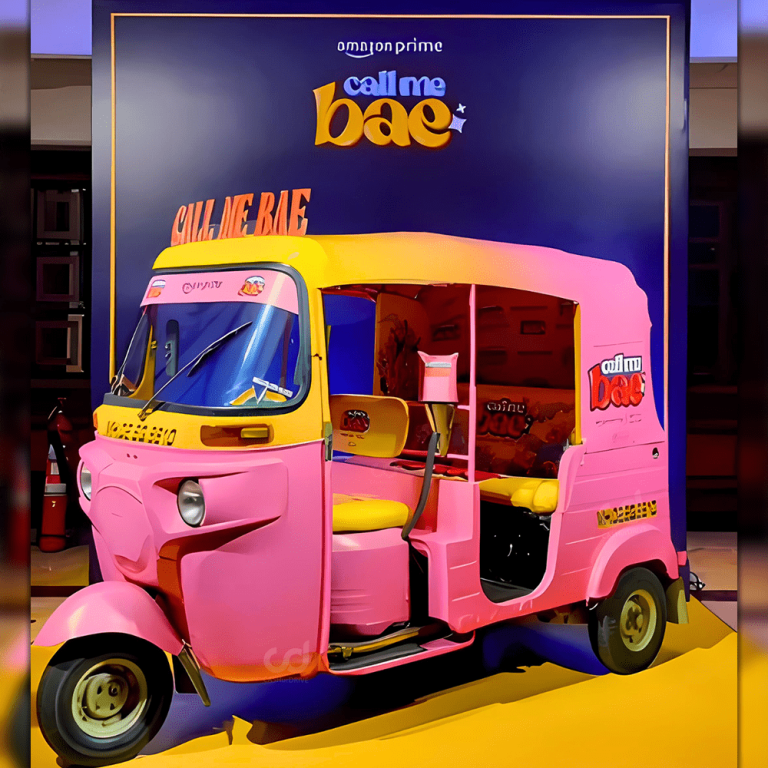
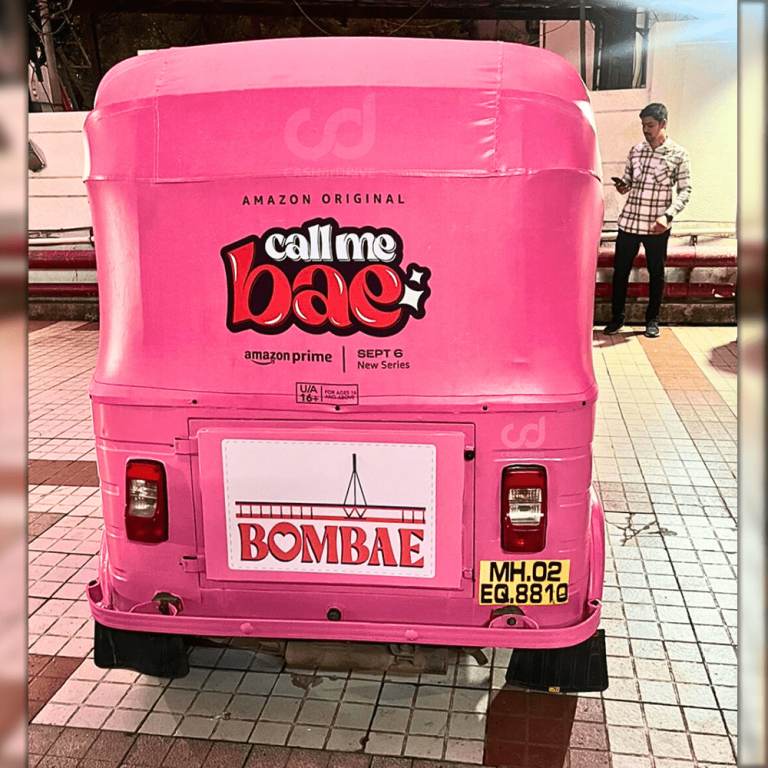
- Full Wrap Activation: This is the premium format. The entire auto exterior – body, hood, and all visible panels – is fully covered with your creative. Maximum visibility from every angle. Pedestrians, vehicles behind, co-commuters – all see it. The auto becomes a moving billboard for your brand. This is the format for launches, festive campaigns, and any situation where maximum recall is the objective.
▶ ₹35,000 per auto + applicable taxes | One-time campaign activation
- Auto Hood Branding: Branding focused on the hood – the front-facing surface of the auto. Visible to pedestrians approaching from the front, to people at auto stands, and to commuters facing the auto in traffic. A cost-efficient format for brands that want visible presence without a full exterior commitment.
▶ Starting at ₹475 onward | One-time campaign activation
- Vinyl Sticker Branding: The most accessible format. Flexible options across three placement types:
- Back panel sticker – placed on the rear of the auto. What every vehicle behind it sees at signals and in slow traffic. High dwell time on busy routes.
- Rear glass branding – applied to the rear windshield. Works well for short-copy messaging, logo placement, or QR code campaigns.
- Side panel vinyl stickers – placed on left and right panels. Visible to pedestrians on the pavement and co-commuters in adjacent lanes.
▶ Starting at ₹275 onward | One-time campaign activation
The right format depends on your objective and budget. Full Wrap Activation delivers the highest recall and brand presence. Vinyl Sticker Branding lets you scale fleet size cost-efficiently for sustained catchment coverage. Most festive and launch campaigns opt for Full Wrap. Always-on regional campaigns often use Vinyl Sticker formats to maintain a wider fleet within campaign budget.
Not sure which format fits your campaign? Use Atlas to map audience density by zone before locking your format and fleet mix. Get a free Atlas zone analysis → /atlas
Which Cities and Routes Work Best for Auto-Rickshaw Advertising?
Auto-rickshaw advertising works in any city with a significant auto fleet. Here’s where it performs strongest:
Delhi NCR: 1.5 lakh+ registered autos operating across permit zones in South Delhi, East Delhi, and satellite towns like Noida and Gurgaon. Strong for FMCG, D2C, and healthcare brands targeting residential catchments.
Mumbai: 4 lakh+ autos operating in permit zones across suburbs. Dadar, Andheri, Bandra, Kurla, and Thane are the highest-density zones. Auto advertising reaches audiences in areas where rickshaws are the primary last-mile mode.
Bengaluru: 1.3 lakh+ autos covering residential zones across South and North Bengaluru. Strong for tech brand campaigns targeting the salaried professional commuter moving between metro stations and residential colonies.
Pune: High auto density in Shivajinagar, Kothrud, Hadapsar, and Pimpri-Chinchwad. One of the best cities for auto advertising during Ganesh Chaturthi, when the auto is the dominant neighbourhood transport.
Hyderabad and Chennai: Growing auto fleets with strong catchment in Old City zones and residential corridors. Effective for education and healthcare brands with hyperlocal messaging requirements.
Route types that deliver the most:
- Market corridor routes – autos running between residential areas and local commercial hubs
- Station feeder routes – last-mile from metro or bus station to neighbourhood
- School and college catchment routes – morning and evening trips through educational zones
- Hospital corridor routes – effective for healthcare and pharmacy brands
When Should You Book Auto-Rickshaw Advertising for the Festive Season?
Auto-rickshaw advertising is the dominant hyperlocal festive format in India’s Tier 1 cities. In Mumbai and Pune specifically, it fills up faster than any other transit format during Ganesh Chaturthi.
Here’s the timeline that matters right now:
Ganesh Chaturthi: September 14, 2026: Mumbai and Pune auto inventory books out 4–6 weeks ahead. That window closes in August. Full Wrap Activation autos placed before September 14 are active during the highest street footfall period of the year in both cities.
Navratri: October 11 & Diwali: November 8: For the broader festive arc across Delhi, Bengaluru, and Hyderabad, campaign bookings need to be confirmed in August for October execution.
Brands that book in August get the routes they want. Brands that book in October get what’s left.
Auto-rickshaw advertising isn’t about reach. It’s about depth – going into the neighbourhoods where your audience lives, not just the roads they use to leave them.
▌ EXPERT INSIGHT – Campaign Operations, CashUrDrive Mumbai
Auto-rickshaw campaigns in Mumbai operate under the Regional Transport Office permit system – autos are licensed to specific zones and cannot legally operate outside their permit area. If you want coverage across Andheri West, Bandra, and Dadar in the same campaign, you need autos permitted for each zone separately. A single city-wide auto brief has to be split by permit zone before it becomes an executable plan. This is the detail most brands miss when they first brief an auto campaign.
During Ganesh Chaturthi in Mumbai, demand for Full Wrap Activation inventory from local businesses – mandal sponsors, FMCG brands, quick service restaurants – compresses the booking window significantly. In 2025, premium zone inventory in Dadar and Kurla was fully committed six weeks before the festival. Brands that came to us in late August got lower-density zone options at best. The Ganesh Chaturthi window in Mumbai closes in early August, not September.
What is the Cost of Auto-Rickshaw Advertising in India?
Two things to clarify before we get into numbers.
Auto-rickshaw advertising is NOT billed monthly. And pricing is NOT based on city tiers.
It’s a one-time campaign activation cost per auto. You pay once, per auto, for the campaign period. No recurring monthly billing. No city-tier price brackets. The cost depends on which format you choose, how many autos you activate, and the scope of your campaign.
Format Pricing at a Glance
| Format | What It Covers | Activation Price |
| Full Wrap Activation | Complete exterior — body, hood, all visible panels | ₹35,000 per auto + applicable taxes |
| Auto Hood Branding | Hood | Starting at ₹475 per auto onward |
| Vinyl Sticker Branding | Back panel | Starting at ₹275 per auto onward |
All pricing is structured as a one-time campaign activation. Fleet size, zone coverage, and campaign duration are planned on a per-campaign basis. For a customised plan and current availability, contact CashUrDrive directly.
CPM Efficiency Comparison: Auto-Rickshaw vs Billboard vs Digital Display
The numbers below settle the Auto branding vs billboard debate on CPM and show exactly where digital display fits in:
| Metric | Auto-Rickshaw | Traditional Billboard | Digital Display |
| Full Wrap cost | ₹35,000 per auto (one-time activation) | ₹50,000 – 2,00,000 per site/month | ₹10,000 + min. spends (CPM-based) |
| Impressions | High-frequency daily on fixed routes | ₹50,000–2,00,000 per site/month | Variable (platform-set) |
| Real-world viewability | 100% — human, in person | 100% — fixed location | 40–60% industry avg |
| Ad skip / block rate | 0% | 0% | 25–40% (ad blockers) |
| Hyperlocal lane access | Yes – residential, market lanes | No – fixed location only | Yes – via geo-targeting |
| Audience verification | Atlas geofencing (pre-campaign) | DEC estimate only | Cookie / device-based |
| Pricing model | One-time per campaign | Monthly per site | CPM / daily budget |
The key advantage of the one-time pricing model: unlike a billboard billed monthly or a digital ad billed per click, your auto campaign cost is fixed from day one. The longer the campaign runs, the lower your effective cost-per-impression becomes.
Want a smarter fleet plan? Atlas audience data lets you concentrate your auto fleet on the highest-density routes for your target segment – reducing wasted impressions and maximising campaign value. See how Atlas optimises auto campaign planning → /atlas
Who Should Use Auto-Rickshaw Advertising?
Auto-rickshaw advertising is built for brands with a hyperlocal objective. Here’s who gets the strongest results:
- D2C brands entering new cities – vehicle advertising in residential zones builds neighbourhood-level familiarity before digital acquisition spend kicks in.
- FMCG brands targeting distributor catchments – autos running through the lanes around your distributor’s outlet build brand visibility at the point closest to purchase.
- Quick commerce platforms – auto wraps in dark store catchment zones reinforce app download intent from the exact audience the platform is trying to convert.
- Education and coaching institutes – route-targeted auto campaigns through school and college zones reach students and parents during morning and evening commutes.
- Healthcare and pharmacy brands – hyperlocal auto campaigns near hospitals, clinics, and pharmacy clusters build community trust in a way no digital ad can replicate.
- Real estate developers – auto campaigns in the residential zones adjacent to a project reach prospective buyers during their daily commute through the neighbourhood.
Frequently Asked Questions
Q1. What is auto-rickshaw advertising and how does it work?
Auto-rickshaw advertising wraps brand messages on auto-rickshaws operating in specific city zones, generating continuous impressions on the routes those autos travel daily. In India, autos operate on fixed zone permits, which means a branded auto covers the same residential and commercial catchment repeatedly throughout the campaign. It penetrates residential lanes, market streets, and school routes that no other OOH format can enter.
Q2. What are the three formats available for auto-rickshaw advertising?
There are three formats. Full Wrap Activation (₹35,000 per auto + taxes) covers the entire auto exterior for maximum visibility – the go-to for launches and festive campaigns. Auto Hood Branding (from ₹475 per auto) focuses on the front-facing hood surface. Vinyl Sticker Branding (from ₹275 per auto) covers back panel, rear glass, or side panel placements – the most cost-efficient option for fleet-scale campaigns.
Q3. Is auto-rickshaw advertising priced monthly or as a one-time cost?
Auto-rickshaw advertising in India is structured as a one-time campaign activation per auto – therefore, it is not billed monthly. Because you pay once per auto for the campaign period, Full Wrap Activation is ₹35,000 per auto plus applicable taxes. Additionally, Auto Hood Branding starts at ₹475 per auto, while Vinyl Sticker Branding starts at ₹275 per auto. As a result, this one-time model means your effective cost-per-impression decreases the longer the campaign runs.
Q4. Does auto-rickshaw advertising cost vary by city tier?
No, auto-rickshaw advertising pricing in India is not determined by city tier. Instead, the cost is based on the format you choose, the number of autos activated, and the campaign scope. For instance, Full Wrap Activation is ₹35,000 per auto + taxes regardless of whether the campaign runs in Delhi, Mumbai, or Pune. Thus, there is no standard monthly city-tier pricing framework for this format.
Q5. How far in advance should auto-rickshaw campaigns be booked for the festive season?
For example, for Ganesh Chaturthi in Mumbai and Pune (September 14, 2026), booking should be confirmed by early August – since Full Wrap Activation inventory in premium zones fills 4–6 weeks ahead. Similarly, for Navratri and Diwali campaigns across Delhi, Bengaluru, and Hyderabad, August booking is recommended for October execution. Ultimately, auto inventory moves faster than most transit formats during festival periods because of concentrated demand from local businesses and FMCG brands.
Q6. Can auto-rickshaw advertising be targeted to specific city zones or routes?
Yes, because in India, auto-rickshaws operate under RTO zone permits. Consequently, fleet selection can be restricted to specific zones – such as a neighbourhood, a market area, or a catchment around a school, hospital, or retail cluster. Furthermore, CashUrDrive’s Atlas platform uses device-level geofencing to verify the audience composition of specific auto routes before booking, ensuring that your fleet selection is based on verified audience movement data, rather than guesswork.
Is Auto-Rickshaw Advertising Right for Your Brand?
Auto-rickshaw advertising doesn’t compete with billboards or buses. It goes where they can’t into the lanes, the colonies, and the market streets where your audience actually lives.
With three formats starting from ₹275 per auto, there’s an entry point for campaigns at every scale. And with Ganesh Chaturthi inventory in Mumbai and Pune closing in August, the time to plan is now.
Don’t wait for the routes you want to disappear.
See CuD’s transit media inventory – cab, bus, metro, and auto formats across 5 cities → /auto-advertising
Author: CashUrDrive Editorial Team
This article was produced with AI assistance and reviewed by the CashUrDrive editorial team.